Charts are reproduced from the original Norwegian report.
The property market
The transaction market
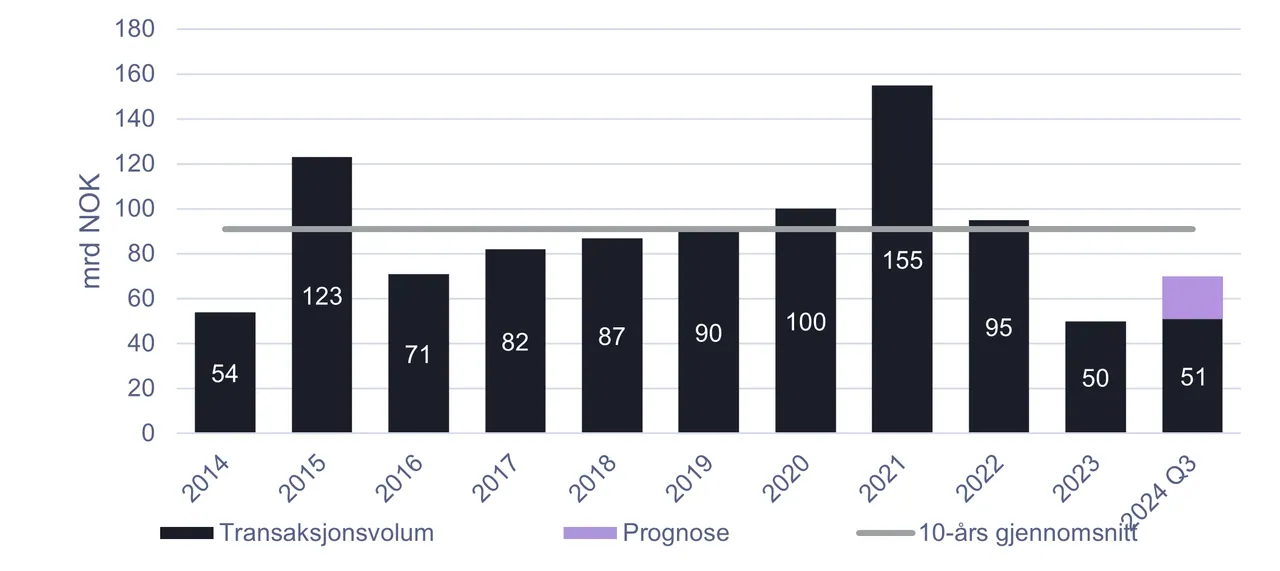
Transaction volume fell somewhat in the third quarter compared with the second quarter. Compared with last year, however, transaction volume for the first three quarters of the year is well above last year's level. As of 20 September, volume had reached approximately NOK 51 bn, spread across just over one hundred transactions. This represents an increase in volume of around 40 per cent compared with the same period last year.
Total volume in Q3 was approximately NOK 8 bn, spread across 26 transactions. Two of these transactions exceeded NOK 1 bn and account for around 35 per cent of total volume in the third quarter. Average transaction size has fallen from the second quarter, but we have also seen several large, benchmark-setting transactions this quarter.
Some of the largest and most notable transactions in the third quarter include:
| Property | Buyer | Seller | Value (NOK m) |
|---|---|---|---|
| Parallell | Malling Core Plus 2023 | Skanska | 632.5 |
| Trekanten kjøpesenter | Scala | Citycon | 1,325 |
| Boligutviklingsportefølje i Oslo | Gjelsten Residential Oslo | Gjelsten Bolig | 1,500 |
| Boligtomt i Asker | JM | Asker Kommune | 464 |
Source: Realnor
Several institutional investors have returned to the market and are acquiring quality properties at attractive pricing. The sellers are typically players looking to reduce their balance sheets or to reallocate capital.
Looking ahead, we expect the transaction market to continue to develop positively as rate cuts draw closer, and market uncertainty has eased amid expectations that the economy is heading for a soft landing. With the prospect of the first rate cut coming during the first quarter of 2025, and with credit margins having adjusted downwards to more normal levels, the pace of investment is expected to pick up as the market continues to move towards equilibrium between buyers' and sellers' price expectations.
The office market
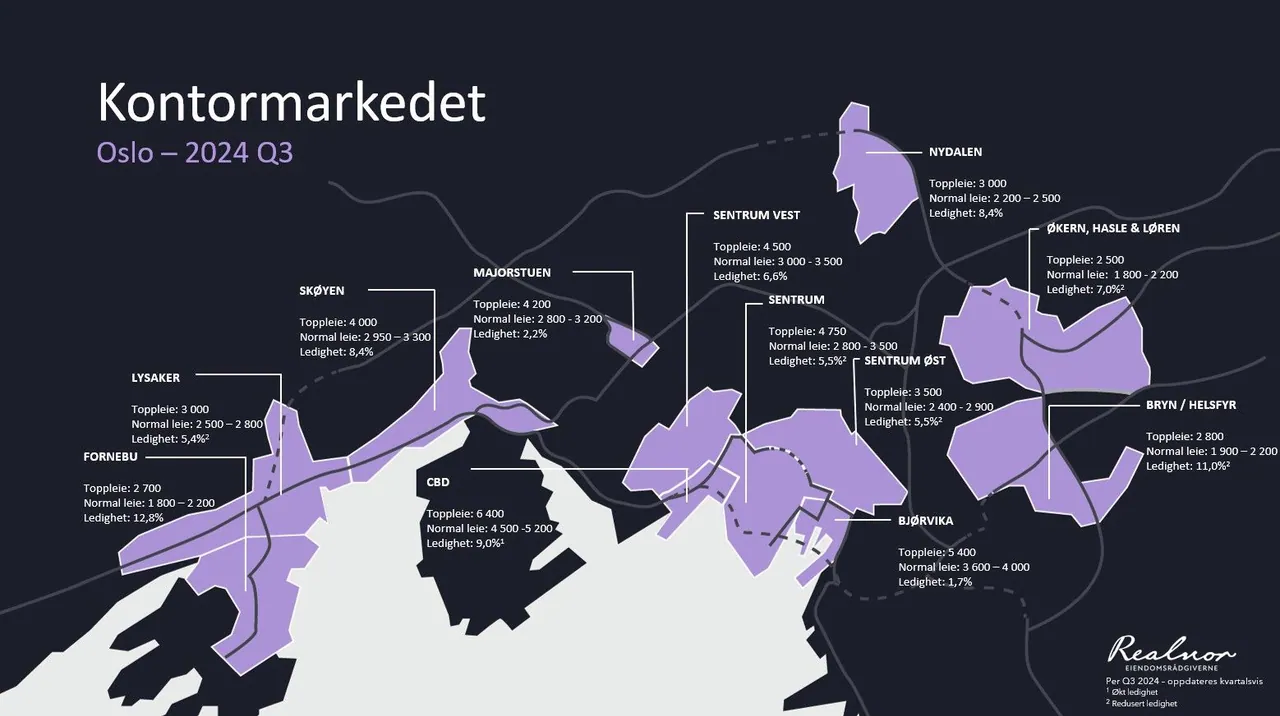
The Oslo office market remains stable, with vacancy just under 7 per cent at the end of the third quarter. Strong demand, limited supply and positive employment figures support this trend, and there are few indications of a sharp slowdown in companies' leasing activity.
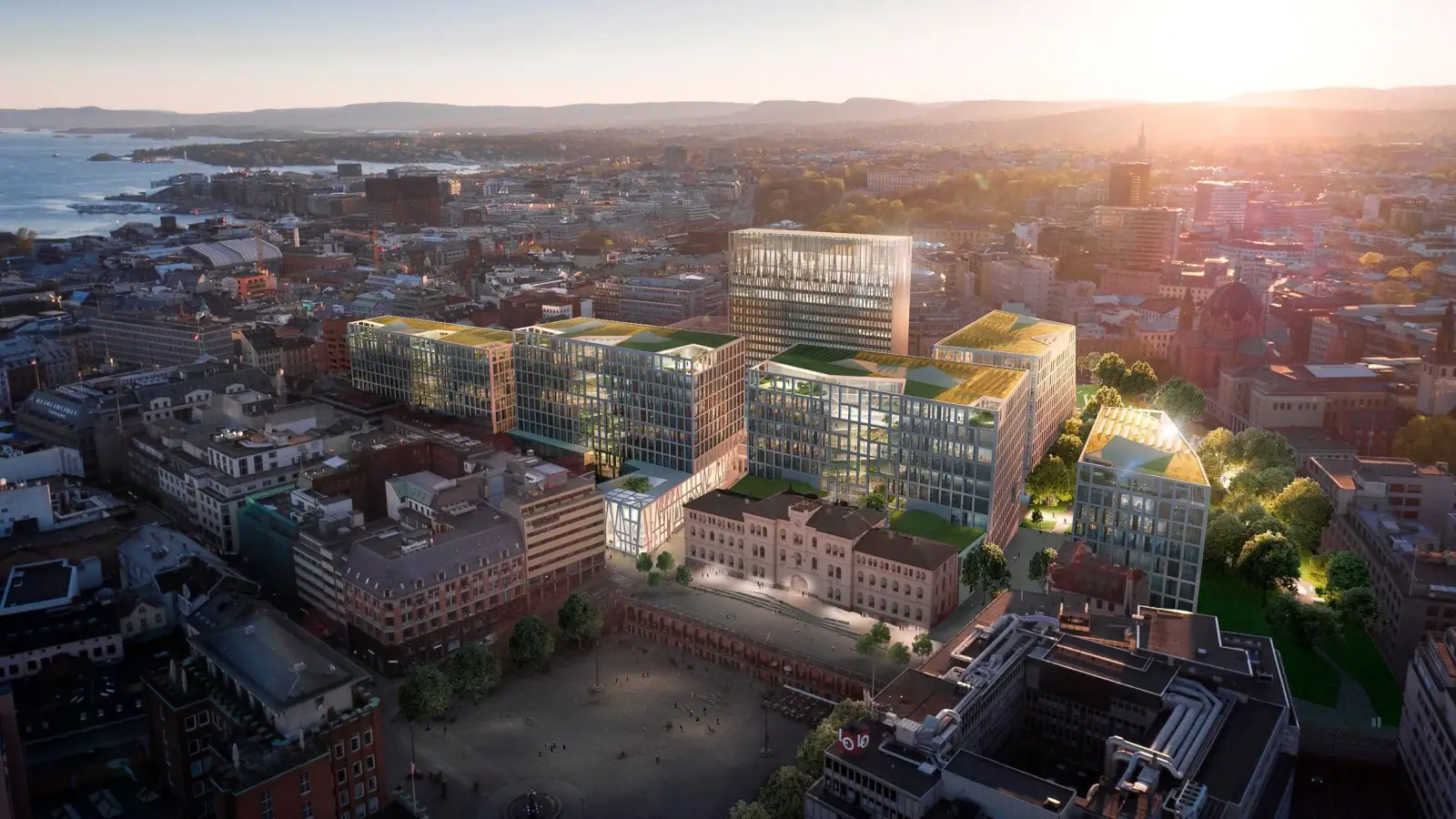
With the exception of the new government quarter, there is little new construction in Oslo, particularly in the city centre, as a result of the high construction costs we have seen in recent years. This constrains supply and contributes to pushing rents upwards. The limited availability of space in the city centre appears to be leading to two scenarios, particularly for larger office occupiers: leases are renegotiated at existing locations, or occupiers look to areas where new construction has been higher, such as the fringe areas. Figures from Arealstatistikk show that rents for signed leases in Oslo as a whole have risen by 6 per cent since the second quarter of 2023. By comparison, signed rents in the city centre have increased by about 10 per cent, while rents at Bryn-Helsfyr have risen by 16 per cent over the same period.
The transaction market for the office segment has risen significantly this year compared with last year, driven by several large, benchmark-setting transactions well in excess of NOK 1 bn. As of 24 September, volume stood at NOK 22 bn, representing almost half of total transaction volume. All the properties were acquired by Norwegian players, whether listed companies, traditional property companies or institutional investors.
In the third quarter it was announced that the fund Malling Core Plus 2023 is acquiring Parallell at Økern from Skanska for NOK 632.5 m. The office building, completed in 2020, comprises 19,000 sq m, with tenants including Bravida and Norsk Gjenvinning.
The logistics market
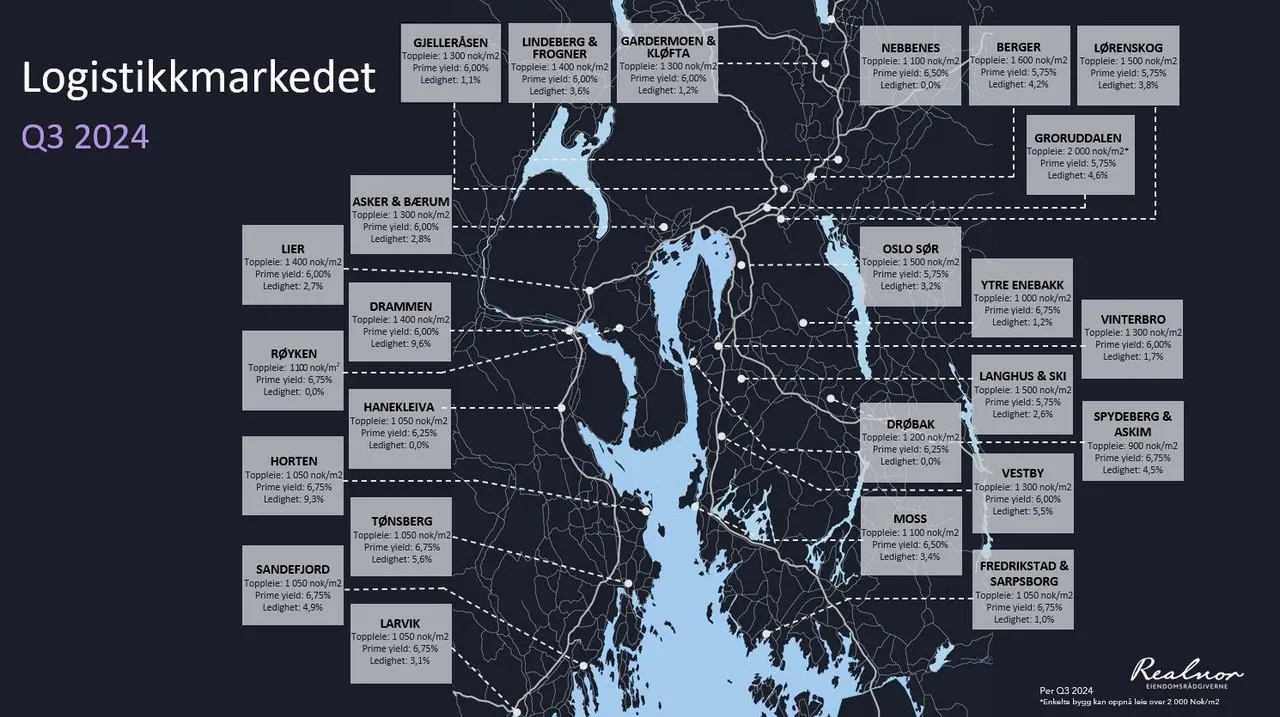
Demand in the logistics market remains strong, and vacancy remains low in Greater Oslo. After a drought in the transaction market in 2023, volume has increased considerably so far this year. Logistics, industrial and mixed-use properties account for approximately 26 per cent of total transaction volume, equivalent to NOK 13.2 bn.
Like the rest of the transaction market, logistics transactions are characterised by few but large deals. So far this year there have been five transactions above NOK 1 bn, all carried out by foreign players. Demand for logistics property remains strong, and market players have great faith in the segment's future.
Vacancy for warehouse and logistics buildings has long been low, standing at around 4.0 per cent in the Greater Oslo region. Despite a relatively high supply of new space in recent years, the market has absorbed it well and vacancy remains stable. However, development potential is very limited in the most sought-after and established logistics clusters around Oslo. In newer logistics areas such as Gardermoen, Enebakk and Drøbak, development potential is considerably greater. Nevertheless, we are observing little new construction as a result of today's high construction costs. Limited supply going forward underpins the expectation of continued low vacancy and positive rental growth. Arealstatistikk reports positive development in rent levels for logistics premises, with rents of NOK 2,000/sq m in the most attractive logistics locations in Oslo, the A segment. At the same time, steeper rental growth is being observed in the B and C segments, underpinned by low new construction activity due to high costs and little vacant space in existing logistics properties up to 2029.
The retail market
Shopping centres
The positive trend for the shopping centre industry in 2023 has continued into 2024, with good figures so far this year. According to Kvarud Analyse, shopping centre sales in the first eight months of the year were 3.2 per cent higher than in the same period last year, adjusted for the number of trading days.
Shopping centres saw sales growth of 3.8 per cent compared with the same month last year, according to Kvarud Analyse. Most of the growth is due to higher volumes, as prices rose by 2.6 per cent from August last year to August this year.
Growth is relatively even across different types of centres and their locations. Finnmark and Innlandet have recorded the highest growth so far this year, with sales increases of 7.2 and 6.6 per cent respectively. District and local centres have seen the strongest growth among the various centre types, with sales growth of 4.3 per cent year to date. Specialist stores have increased their sales the most, with growth of 6.8 per cent so far this year.
Retail trade
According to Statistics Norway's retail trade index, seasonally adjusted retail sales volume rose by 1.2 per cent from June to July. Retail trade has shown little fluctuation in recent periods and the trend is flat, pointing to stable retail trade in recent months.
From July 2023 to July 2024, sales volume fell by 0.5 per cent, while online sales rose by 6.4 per cent over the same period, indicating that online retail continues to grow relative to traditional retail.
Although the retail market is performing relatively well at an aggregate level, there is little activity in the transaction market. There have been a total of 14 transactions so far this year, most of them small, with the exception of Scala's acquisition of Trekanten senter in Asker from Citycon, at a value of NOK 1.325 bn. In total, retail property worth NOK 3.5 bn has changed hands, representing around 7 per cent of total transaction volume. This points to an uncertain market in which investors remain sceptical about the outlook.
Macroeconomy
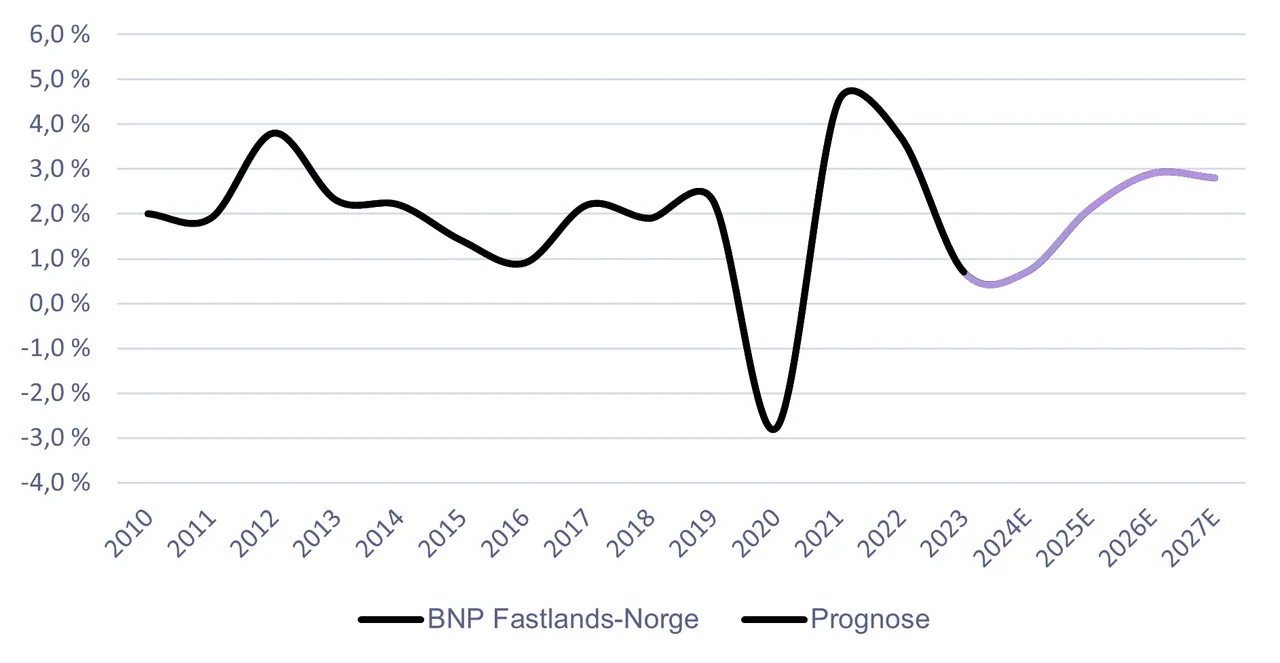
- With mainland GDP growth estimated at 0.7 per cent in 2024, we see continued stagnation in the Norwegian economy this year.
- However, forecasts from Statistics Norway show that activity in the Norwegian economy is expected to increase from 2025 and approach a cyclically neutral level from 2026, owing to higher wage growth, falling inflation and increased public consumption and investment.
- Mainland GDP is projected to grow by 2.1 per cent in 2025, and by 2.9 and 2.8 per cent in 2026 and 2027 respectively.
The labour market
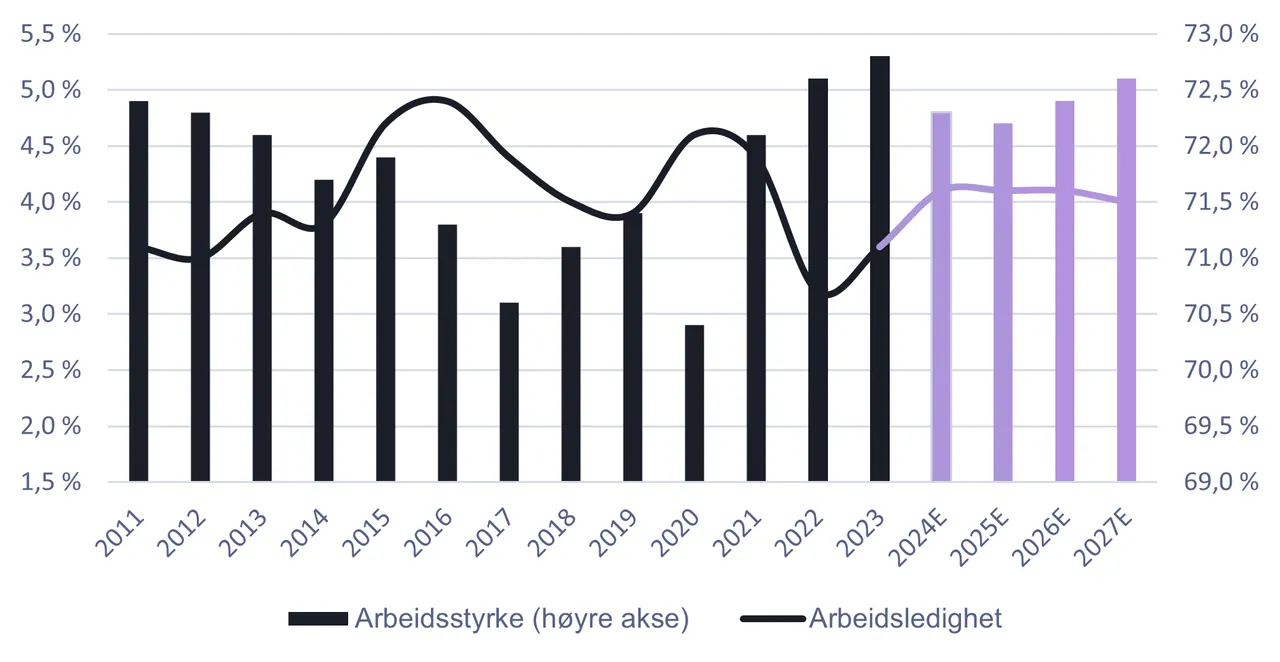
- Unemployment (LFS) came in at 4.0 per cent in July. The labour market is expected to stabilise, with unemployment levelling off at 4.1 per cent up to 2027, while employment is expected to rise slightly, by an average of 0.7 per cent annually, up to 2027.
- Statistics Norway's forecasts imply wage growth of 5.3 per cent this year, before it gradually falls to slightly below 4 per cent towards 2027.
- After several years without real wage growth, Statistics Norway expects real wage growth in 2024 as a result of a downward revision of the inflation forecast and an upward revision of annual wage growth. Average real wage growth up to 2027 is estimated at around 1.5 per cent.
CPI
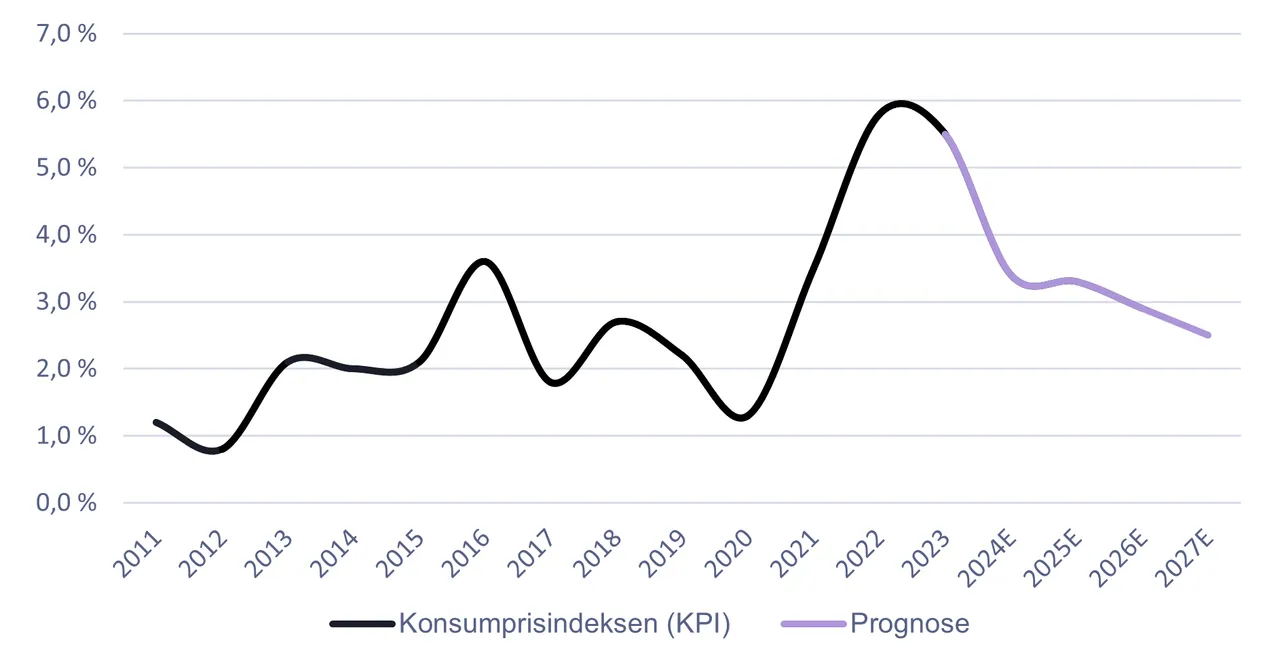
- Twelve-month growth in inflation (CPI) and core inflation (CPI-ATE) was 2.6 and 3.2 per cent respectively in August 2024.
- Since December 2023, twelve-month CPI growth has fallen from 4.8 per cent.
- Price growth continues its downward trend, and Statistics Norway estimates increases in CPI and CPI-ATE of 3.4 and 3.9 per cent respectively for 2024. This is a downward revision from previous reports.
- It is mainly an unexpectedly large decline in price growth for electricity and package holidays that is helping to dampen CPI. Twelve-month growth in CPI-ATE has continued to slow each month since November 2023, but remains higher than CPI because electricity prices are excluded from CPI-ATE.
- Annual CPI growth is projected to fall gradually further towards the inflation target of 2 per cent over the next three years.
The interest rate market
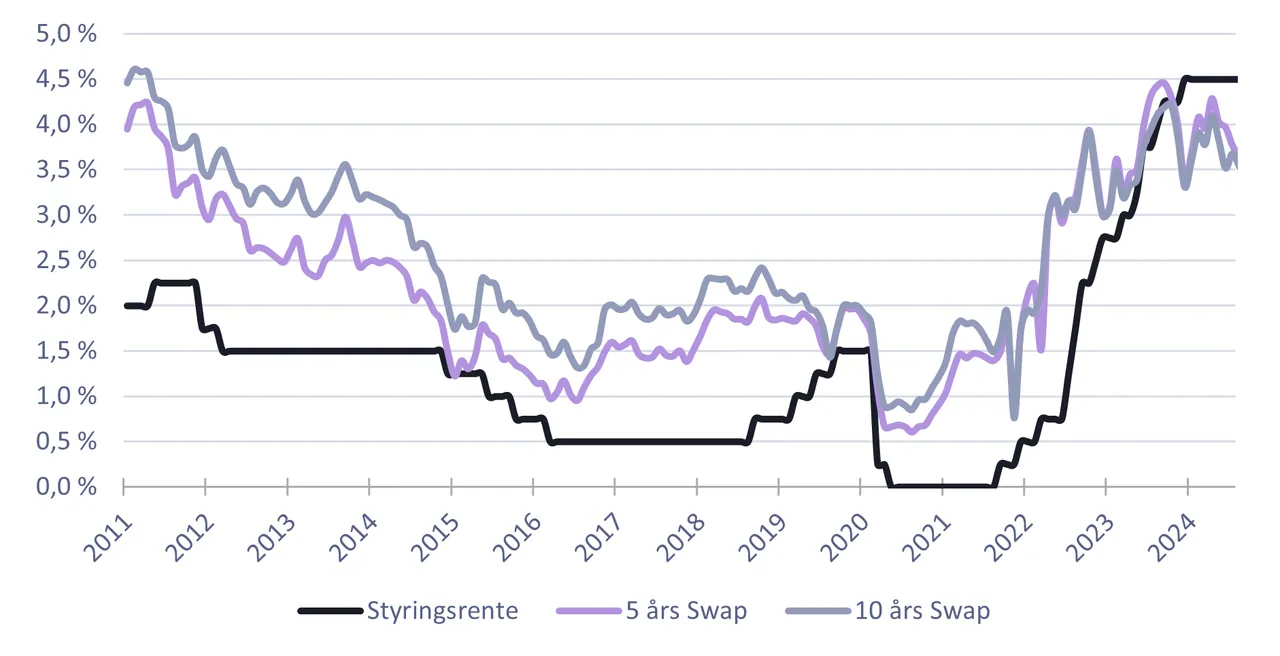
- The policy rate was held unchanged at 4.50 per cent following Norges Bank's interest rate decision in September 2024.
- Norges Bank has kept its rate path broadly unchanged from the previous report, but indicates a slightly faster decline in the rate through 2025.
- Expectations of lower wage and price growth than previously, as well as lower policy rates among Norway's trading partners, are pulling the rate path down, while the krone exchange rate and petroleum investment are pushing it up somewhat.
- Five-year swap rates fluctuated between 3.4 and 3.8 per cent in Q3 2024.