Charts are reproduced from the original Norwegian report.
The property market
Large transactions lift half-year volume well above last year
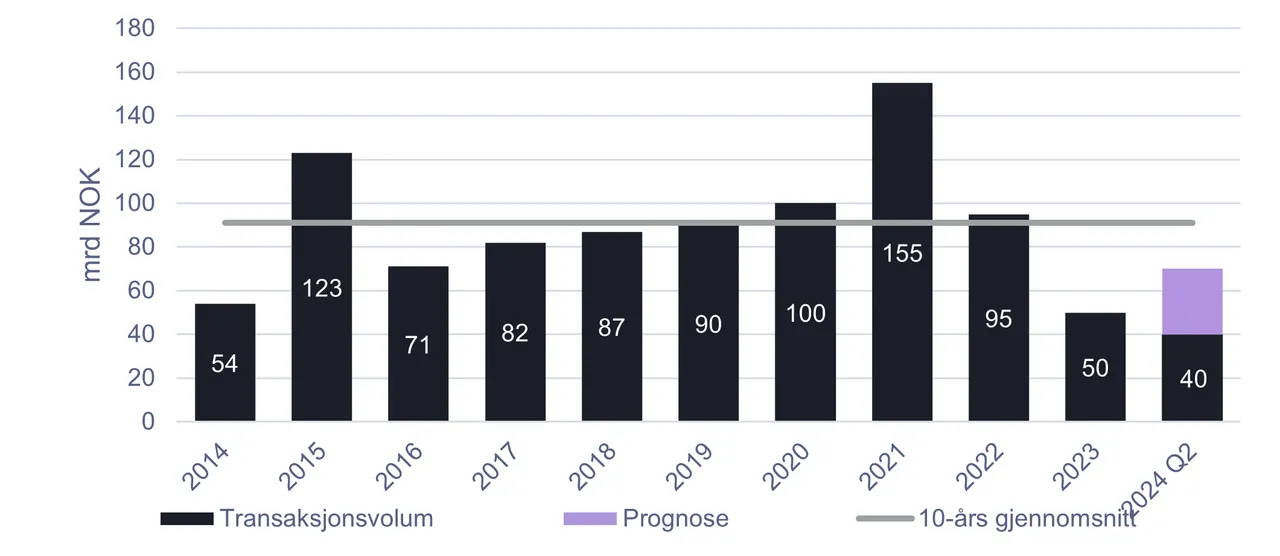
Transaction volume fell in the second quarter compared with the first quarter. Compared with last year, however, the quarter was significantly better, and half-year volume is far above last year's level. For the first half of the year, volume was NOK 39.5 bn, spread across 77 transactions. This represents an increase of 59 per cent compared with the same point last year.
The trend in the second quarter resembles that of the first quarter, with few but relatively large transactions. Total volume in the second quarter was just over NOK 16 bn, spread across 41 transactions. Six of these transactions exceeded NOK 1 bn and together account for over 50 per cent of total volume in the second quarter. Average transaction size has fallen from the first quarter, but we have also seen several large, benchmark-setting transactions this quarter.
| Property | Buyer | Seller | Value (NOK m) |
|---|---|---|---|
| SBB portefølje | Public Property Invest | SBB | 1,640 |
| Ahlsell sentrallager | Niam | Logistic Contractor | 1,450 |
| Diagonale Bjørvika (100%) | KLP | Aspelin Ramm | 3,000 |
| K8 Stavanger | Storebrand | Base | 1,050 |
| Lysaker Park | Storebrand | Artic-syndikat | 1,700 |
Source: Realnor
Several life insurance companies and institutional investors have returned to the market and are acquiring quality properties at attractive pricing. The sellers are typically players looking to reduce their balance sheets or to reallocate capital.
Looking ahead, we expect developments similar to those seen in the second quarter. Norges Bank has raised its rate path somewhat, and it is likely that there will be no rate cut before 2025. Nevertheless, the market appears to be approaching an equilibrium in which buyers and sellers have similar expectations. At the same time, we are still seeing processes take longer than before because of sellers' excessively high price expectations.
The office market accounts for half of transaction volume
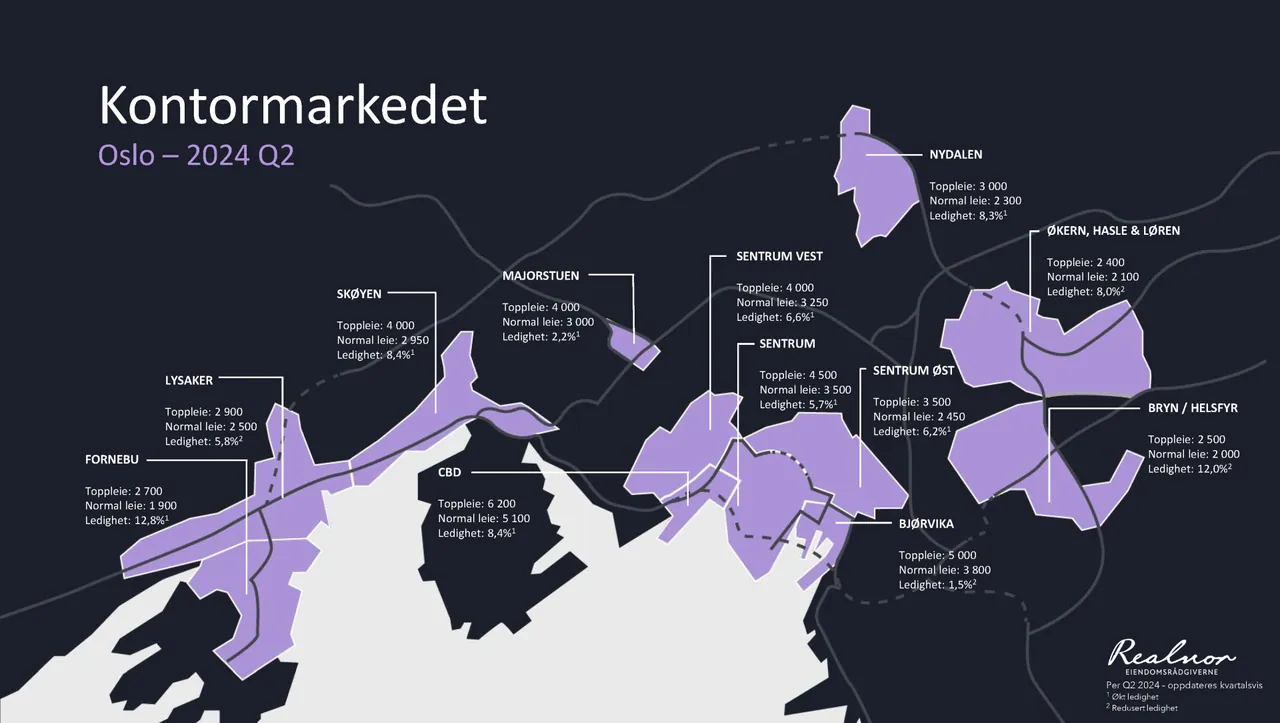
The Oslo office market remains relatively stable, despite a gradual increase in vacancy. In June 2024, the six-month moving average vacancy rate rose to 7.2 per cent from 6.4 per cent at the start of the year. Although vacancy has risen steadily since mid-2023, it remains at a moderate level. Strong employment figures support this trend, and there are few indications of a sharp slowdown in companies' search activity.
There are, however, significant differences in the leasing market. In areas such as Helsfyr and Fornebu, vacancy is well above 10 per cent, making it a tenant's market. In contrast, vacancy is low in the CBD, Bjørvika and the city core, where supply is limited. This puts pressure on rents and leads to a high level of renegotiations, particularly among large occupiers requiring large floor areas, optimal locations and new-build standard. In this segment, choice is even more restricted.
Rents and the number of square metres of office space signed are also holding at relatively stable levels, according to Arealstatistikk. The transaction market for the office segment has risen significantly this year compared with last year. In the first half of the year, volume exceeded NOK 20 bn, representing more than half of total transaction volume. Volume in the office segment has almost tripled compared with the first half of 2023. Eight of the transactions exceeded NOK 800 m, all of them acquired by Norwegian players, whether listed companies, property companies or institutional investors.
The logistics market – high demand in established logistics clusters
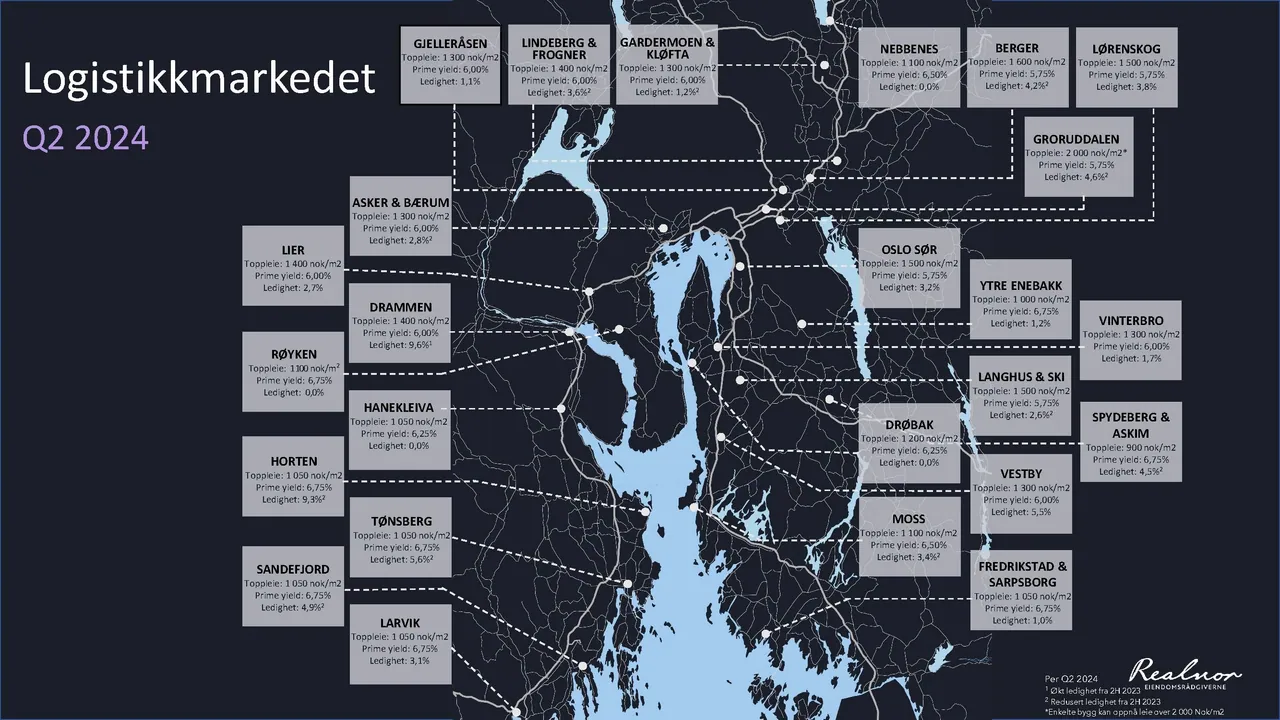
Demand in the logistics market remains strong, and vacancy remains low in Greater Oslo. After a drought in the transaction market in 2023, volume has increased considerably so far this year. Logistics, industrial and mixed-use properties account for approximately 21 per cent of total transaction volume, equivalent to NOK 8.0 bn. We are seeing an increasing share of capital allocated to centrally located logistics properties, and in our view volume would have been significantly higher had more owners been willing to sell their properties.
Like the rest of the transaction market, logistics transactions have been characterised by few but large deals. During the first half of the year there were four transactions above NOK 1 bn, all carried out by foreign players. The office market is perceived as very challenging in the US and Europe, with significant declines in value in several cities, leading more investors to favour the warehouse and logistics segment, which is perceived as more stable. Demand for logistics property remains strong, and market players have great faith in the segment's future. We expect this trend to continue.
Appetite for logistics property is also high among Norwegian players. Pareto recently raised NOK 1.3 bn for its logistics fund, mainly from Norwegian institutional investors. In the second quarter it was also announced that KMC Properties is merging with the Swedish company Logistea, bringing industrial and warehouse properties worth around NOK 3.26 bn into the Swedish company.
Vacancy for warehouse and logistics buildings has long been low, standing at around 4.0 per cent in the Greater Oslo region. Despite a relatively high supply of new space in recent years, the market has absorbed it well and vacancy remains stable. However, development potential is very limited in the most sought-after and established logistics clusters around Oslo. In newer logistics areas such as Gardermoen, Enebakk and Drøbak, development potential is considerably greater.
In addition, one significant development site remains in an established logistics area at Vestby næringspark. The detailed zoning plan for the property was adopted in May this year and allows for approximately 115,000 sq m of new buildings with ceiling heights of between 25 and 30 metres. The property was acquired by Bulk for over NOK 500 m, equivalent to NOK 3,050/sq m for the zoned area (166,000 sq m). The price is far above previously observed prices in Vestby and illustrates the attractiveness of established and sought-after logistics areas.
The retail market
Shopping centres increased sales in the first half
The positive trend for the shopping centre industry in 2023 has continued into 2024, with good figures so far this year. According to Kvarud Analyse, shopping centre sales in the first six months of the year were 3.8 per cent higher than in the same period last year, adjusted for ongoing and completed projects.
In the second quarter, record warm weather in May contributed to sales growth of as much as 8.0 per cent compared with the same month last year. Most of the growth is due to higher volumes, as prices rose by 3.0 per cent in May compared with May last year.
Growth is relatively even across different types of centres and their locations. Finnmark has recorded the highest growth so far this year, with a sales increase of 7.7 per cent. District and local centres have seen the strongest growth among the various centre types.
Although the retail market is performing relatively well at an aggregate level, there is little activity in the transaction market. There have been a total of 10 transactions so far this year, most of them small. In total, retail property worth NOK 1.7 bn has changed hands, and its share of total transaction volume is at historically low levels. This points to an uncertain market in which investors remain sceptical about the outlook.
Flat trend in traditional retail, while online retail grows
According to Statistics Norway's retail trade index for June, seasonally adjusted retail sales volume fell by as much as 5.1 per cent from May to June. This followed an increase of 4.7 per cent in May, a month of unusually strong growth. For the second quarter as a whole, sales volume increased compared with the first quarter of the year.
The decline in June was mainly driven by groceries and clothing stores, the same sectors that accounted for most of the growth in May. Despite relatively large fluctuations from May to June, Statistics Norway stresses that the trend remains relatively flat, as it has been up to May this year.
Online retail has shown an increase of 10 per cent from January to May this year, indicating that online retail continues to grow relative to traditional retail.
Macroeconomy
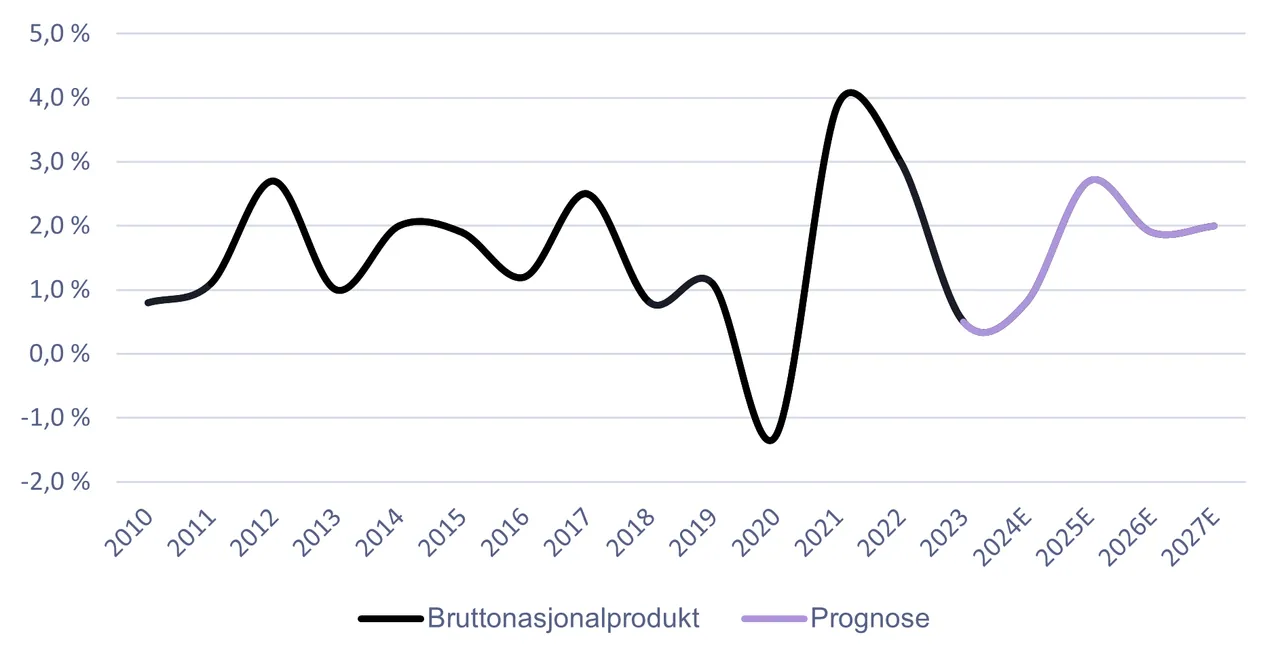
- The stagnation in the Norwegian economy has continued so far in 2024, but according to Statistics Norway it will soon be over.
- Activity in the Norwegian economy is expected to pick up in the period ahead, while inflation continues to fall.
- Statistics Norway's forecasts show activity in the Norwegian economy picking up clearly in 2025 and approaching a cyclically neutral situation from 2026.
- Mainland GDP is projected to grow by 0.5 per cent in 2024 and by between 2 and 3 per cent in 2026 and 2027.
The labour market
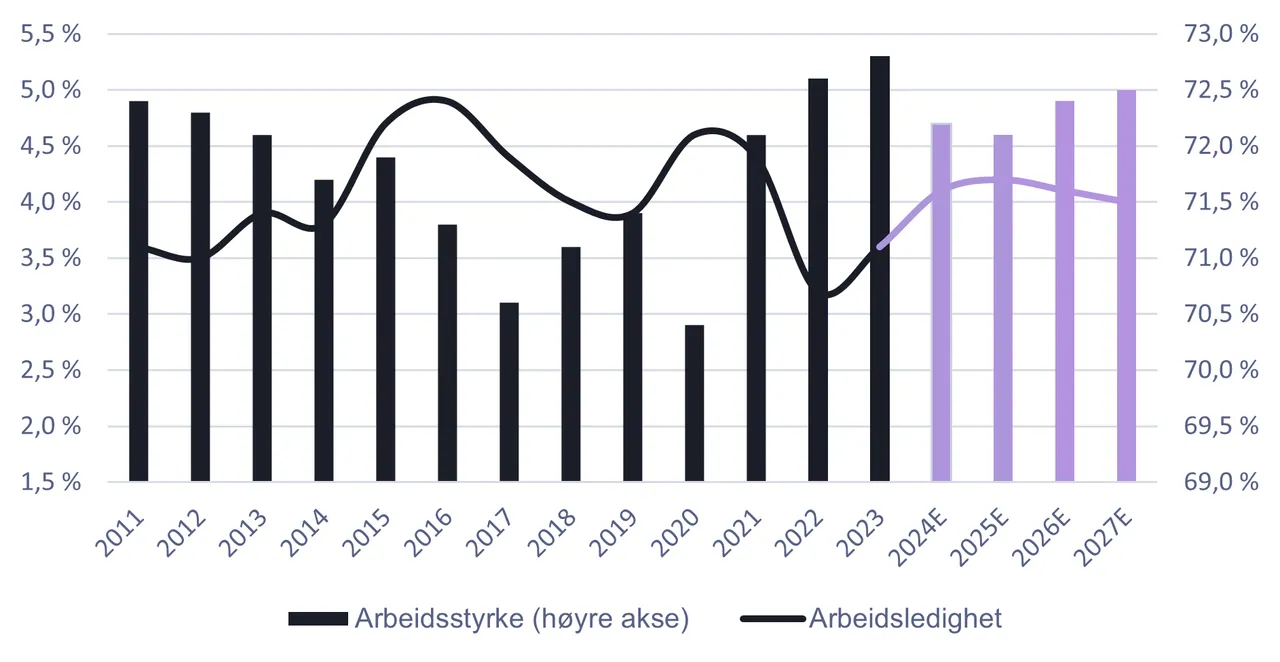
- Unemployment of 4.1 per cent in June (LFS). The labour market is weakening, with rising unemployment and a slight decline in employment and the number of jobs.
- After many years without real wage growth, Statistics Norway expects real wage growth in 2024 and the coming years. According to the forecasts, wage growth will be 5.2 per cent in 2024, before falling to slightly below 4 per cent in 2026 and 2027.
- Statistics Norway expects unemployment to rise going forward, driven largely by the many Ukrainian immigrants.
- The fall in residential investment also means that more people will become unemployed in the construction industry.
- Unemployment is expected to remain at around 4.1 per cent this year, before rising further to around 4.2 per cent in 2025.
CPI
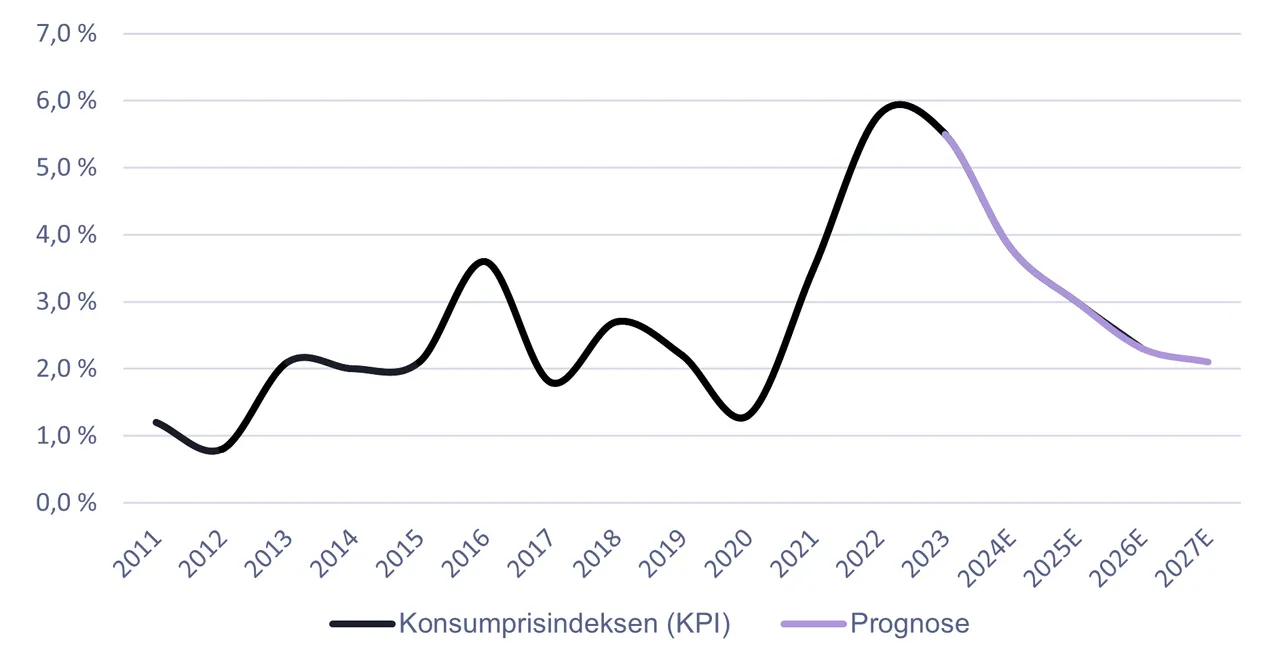
- Twelve-month growth in inflation and core inflation of 2.6% and 3.4% respectively in June 2024
- Price growth fell in the second quarter for the sixth month in a row, reaching its lowest level in over three years in June.
- Food prices continue to rise and were 4.9 per cent higher in June this year than last year. Nevertheless, food prices are rising less than they have over the past two years.
- Core inflation (CPI-ATE) has slowed every month since November last year, but remains higher than CPI because electricity prices are not included in CPI-ATE.
- Annual inflation is projected at 3.8 per cent in 2024, before gradually falling towards the inflation target by 2026, according to Statistics Norway.
The interest rate market
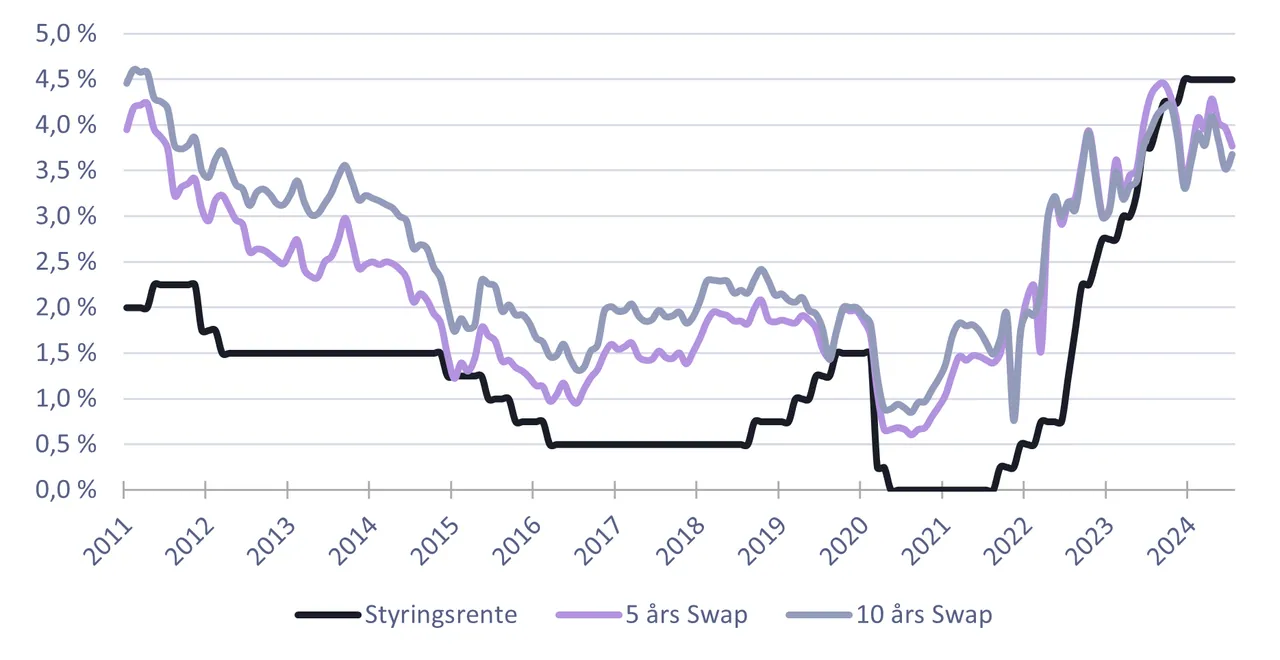
- Swap rates fluctuated between 3.5 and 4.3 per cent in Q2 2024.
- The policy rate was held unchanged at 4.50 per cent following Norges Bank's interest rate decision in June 2024.
- Norges Bank has raised its rate path somewhat from the previous report and believes it will be necessary to keep the rate at its current level for some time to come. The first rate cut is not indicated until 2025.
- A persistently weak krone and concerns about excessively high inflation are pushing up the rate path.