Charts are reproduced from the original Norwegian report.
The property market
The transaction market
With falling inflation, unemployment remaining stable at a low level, expectations of future real wage growth and rate cuts from 2025, we saw indications that the risk associated with property came down somewhat over the past year. Buyers' and sellers' price expectations moved closer together as credit spreads narrowed and the expected rate cuts drew nearer. Towards the end of last year's final quarter, however, greater uncertainty arose regarding precisely those future rate cuts and their frequency, which has resulted, once again, in higher market rates. Going forward, as we have become well accustomed to these days, there will still be considerable suspense surrounding the interest rate level and the factors that influence it.
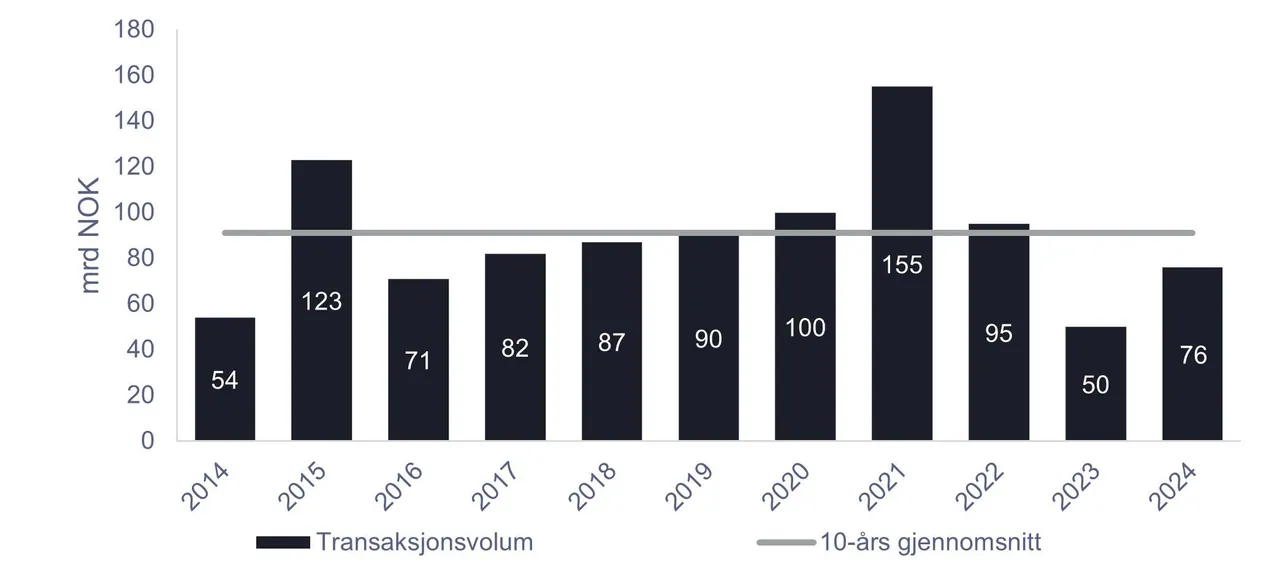
For 2024 we have registered a transaction volume of NOK 76 bn. This is still below the average for the last ten years, but shows a clear improvement in the transaction market from the low point of 2023. Although the transaction market is still characterised by relatively few but large transactions, developments in the final quarter of the year may indicate that liquidity is starting to return to the market, with more, but on average smaller, transactions. Among the larger transactions this quarter, we can highlight Malling's acquisition of the Selmer portfolio, consisting of 15 properties in the Greater Oslo region, the sale of an industrial property in Dusavik in Stavanger for NOK 1 bn, and a couple of larger hotel transactions in Tromsø and Bergen. It is the office and the warehouse, logistics and industrial segments that are leading the way in transaction volume, but we are also observing, particularly in the second half of the year, that hotel property accounts for an increasing share of transaction volume.
The office market
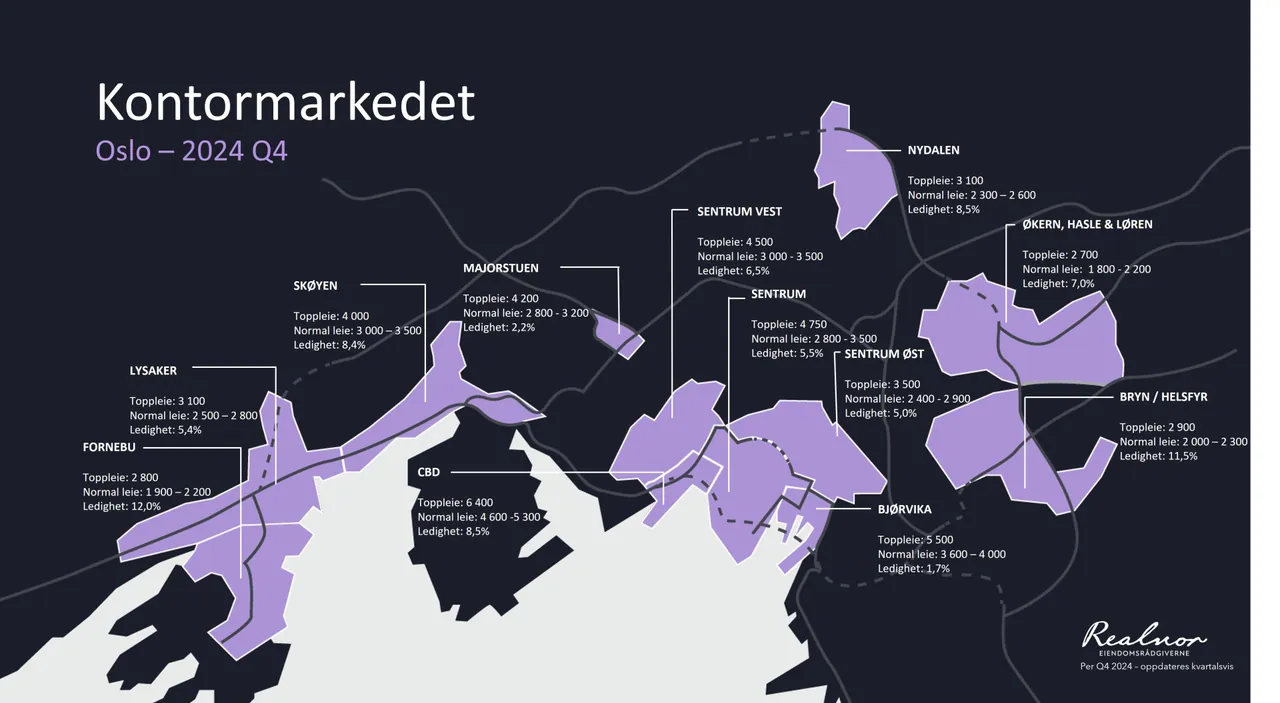
Office vacancy remains stable at 6.9 per cent for Oslo as a whole. It is lowest in the city centre at around 5 per cent and highest at Bryn/Helsfyr and Fornebu, where vacancy is around 12 per cent. Vacancy is expected to rise somewhat going forward as the completion of more new-build and refurbishment projects draws nearer and they are eventually included in the count. At the same time, there are once again expectations of economic growth in Norway in 2025 after a two-year period of near-zero growth. This could provide a boost to an office market that has developed relatively flatly through 2024, in terms of both vacancy and rents.
Figures from Arealstatistikk show that letting volume measured in square metres for office space in Oslo was 664,210 sq m in 2024. This is a decline of 24 per cent from 2023, driven by smaller average sizes of the space let, as letting volume measured by number of contracts (832) is slightly up, by 4 per cent, from 2023 (797).
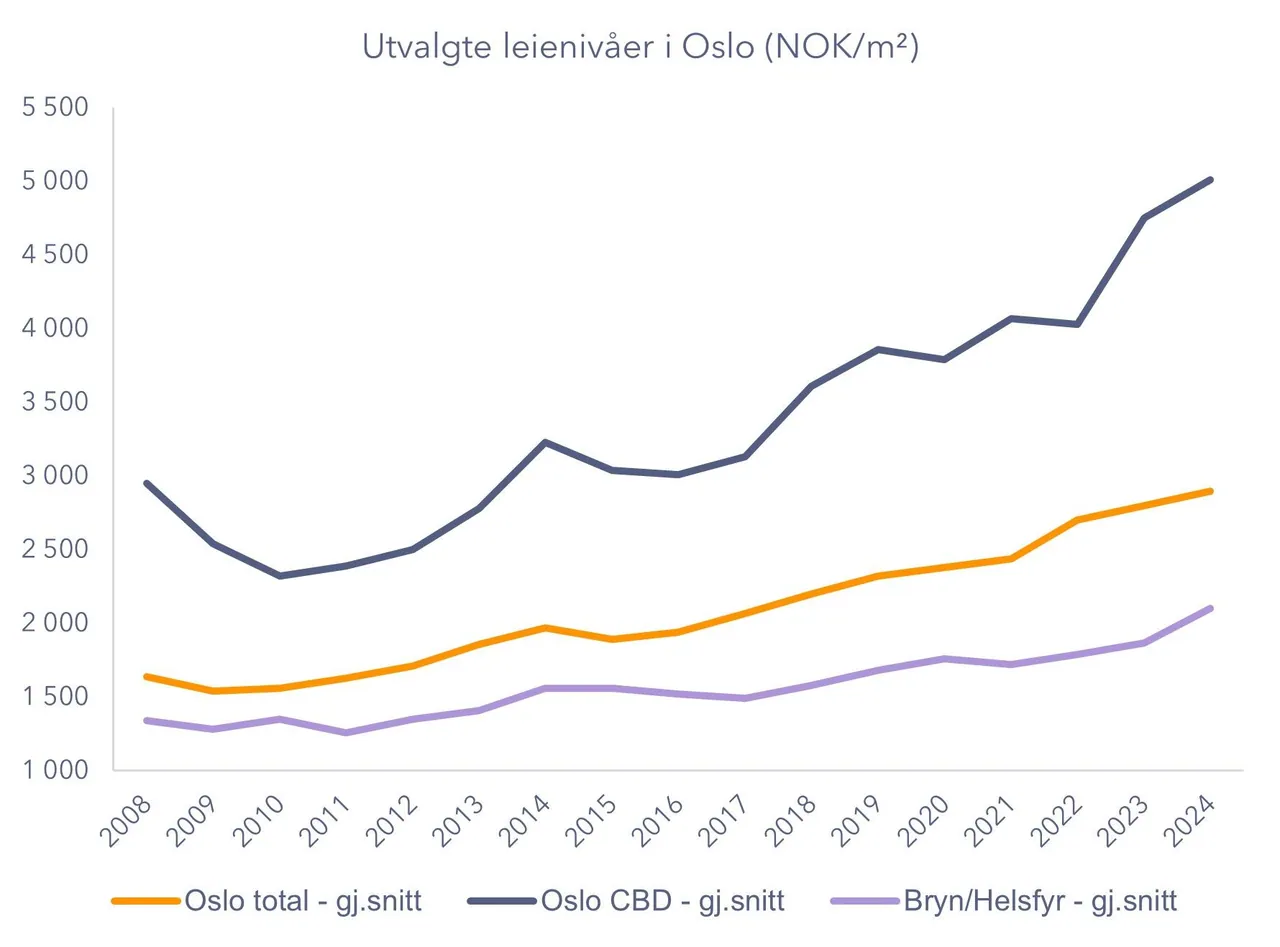
Office rents in Oslo have risen by an average of 3.6 per cent since 2023, according to figures from Arealstatistikk. For office premises in the CBD the increase was on average somewhat higher than for the city as a whole, with rental growth of 5.5 per cent, following a 2023 that showed growth of as much as 18 per cent. The greatest rental growth, however, has been at Bryn-Helsfyr, where the increase from 2023 averaged 12.3 per cent. This development confirms earlier assumptions that more and more companies are moving to Bryn-Helsfyr to obtain new-build standard at lower rents compared with the city-centre core, including many public-sector organisations.
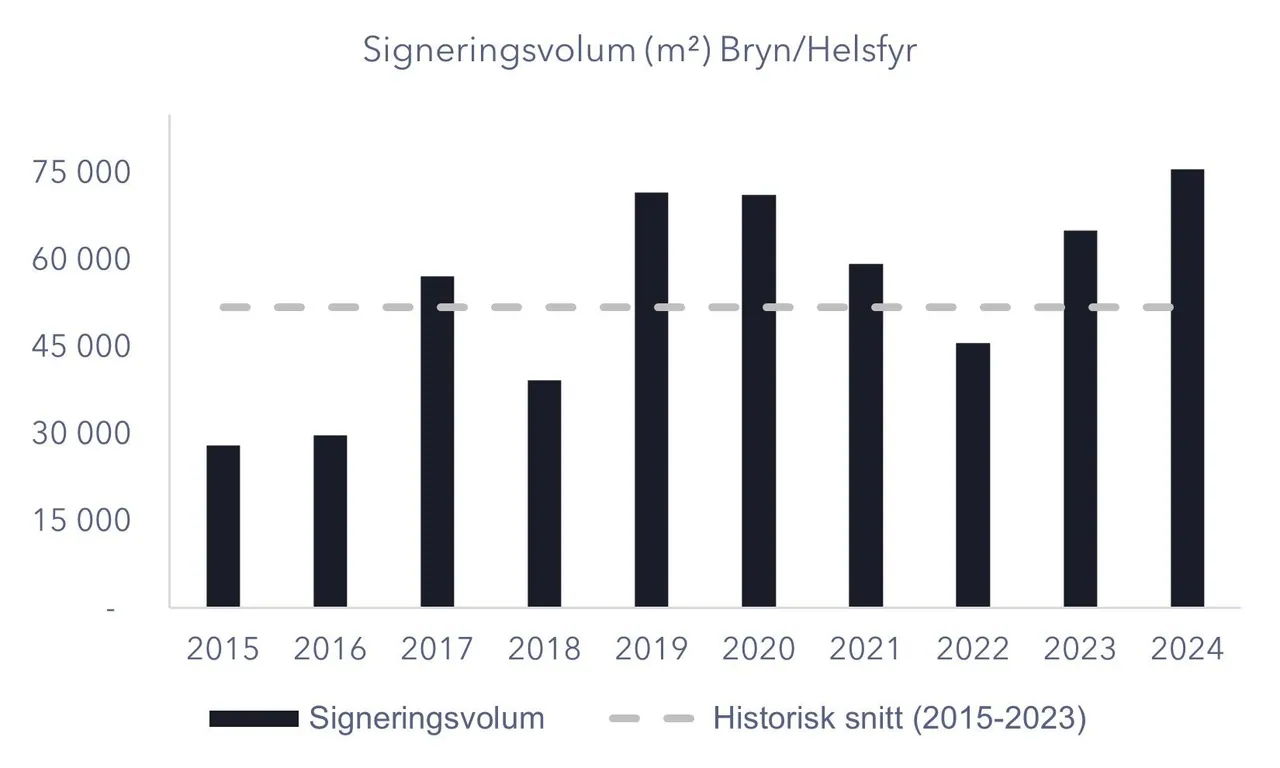
The trend is also evident in letting volume, with a steep rise in the number of square metres let, particularly since 2021. For 2024, the figures show that letting volume was 46 per cent higher than the historical average for the period 2015 to 2023.
The logistics market
Warehouse and logistics, industrial and mixed-use properties accounted for just under 25 per cent of total transaction volume in the past year, which adds up to around NOK 18 bn.
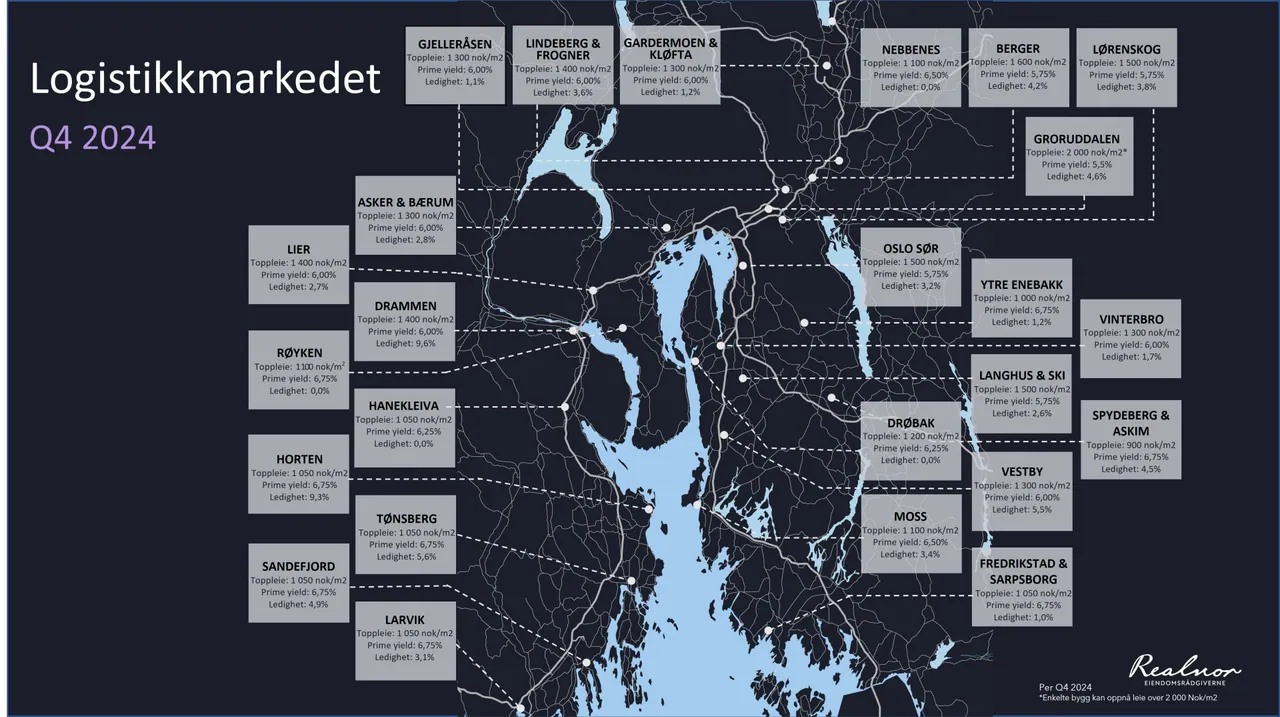
Figures from Arealstatistikk show that the average rent for warehouse premises in Greater Oslo rose by 6 per cent from 2023, to NOK 1,370/sq m. Rental growth for warehouse premises thus continues the strong development we have observed since 2020, with annual growth of 5 to 10 per cent. Rents for the most attractive warehouse premises averaged NOK 2,000/sq m in 2024. This is an increase of 2 per cent from the year before, and confirms the trend we saw over the past year, with rents approaching and exceeding this level.
We believe this trend will continue now that the most attractive warehouse and logistics areas closest to Oslo are more or less fully developed. A limited supply side in these areas will drive rent levels further upwards. The less central areas, and the areas with a significant stock of undeveloped sites, may also experience rental growth, driven by the high level of construction costs. Given current demand for space, there is much to suggest continued rental growth in these areas as well.
The retail market
Shopping centres
In terms of turnover, shopping centre turnover, adjusted for changes in floor space, rose by 3.2 per cent in 2024, according to Kvarud Analyse. The largest contributor to growth came from the service sector, which grew by 6.5 per cent, followed by specialist shops, which saw growth of 5.2 per cent. Turnover growth was greatest in Troms, Nordland and Finnmark, with floor-space-adjusted turnover growth of 6.5, 5.0 and 4.7 per cent respectively from 2023.
In 2024, shopping centre property worth around NOK 3.5 bn changed hands. The largest transaction was carried out by Scala Eiendom when it was announced in September that it had acquired Trekanten senter in Asker from Citycon for NOK 1.325 bn.
Retail trade
Retail property accounted for around 5 per cent of the total transaction market in 2024. Taking the retail and shopping centre categories together, however, they accounted for around 10 per cent of total volume.
According to Statistics Norway's retail trade index, twelve-month growth in retail trade excluding motor vehicles was 4.5 per cent and 4.0 per cent in October and November respectively. Annual growth (as of November) was 3.25 per cent, compared with 1.87 per cent in 2023 and 3.07 per cent in 2022.
With expectations of future real wage growth combined with rate reductions, conditions are in place for retail turnover to continue picking up going forward. Real wage growth and expectations of an increase in private consumption could contribute to increased turnover and attractiveness for the retail and service sector, which could also put pressure on rent levels for retail property.
Macroeconomics
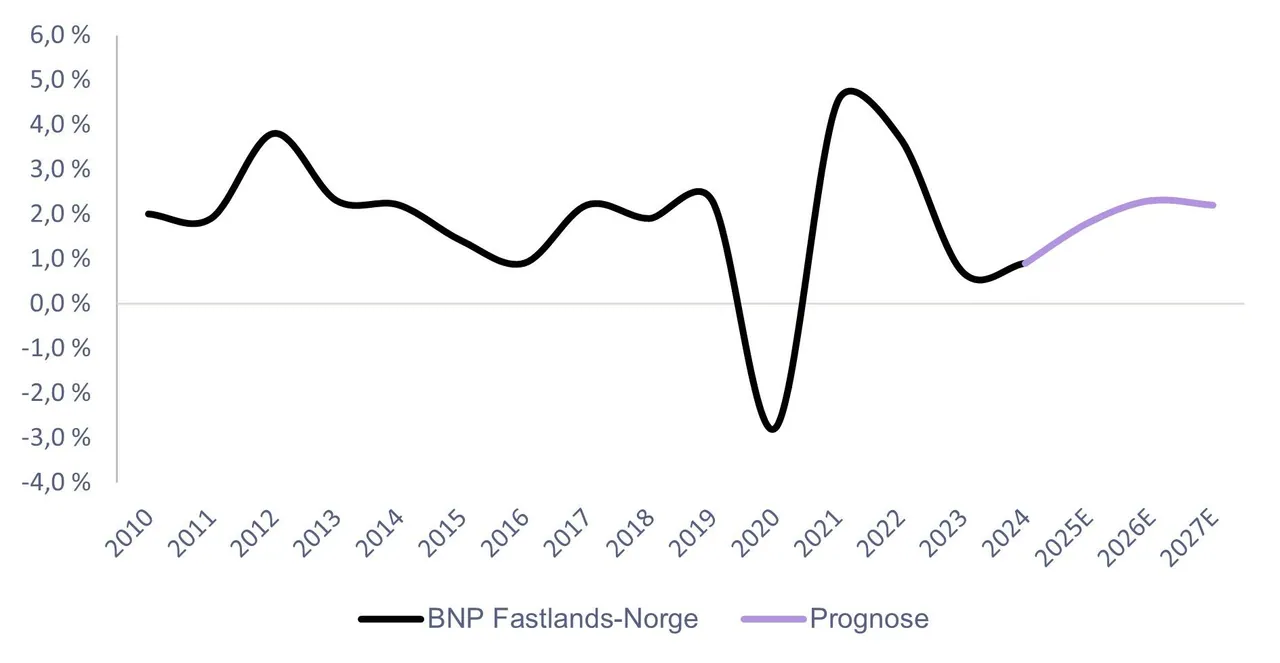
- The Norwegian economy is showing weak growth after a period of relatively flat development in Mainland Norway GDP since 2022.
- Going forward, falling inflation, real wage growth, lower interest rates, increased consumption and investment, particularly in the public sector, are expected to lift activity in the economy.
- Statistics Norway estimates Mainland Norway GDP growth at 0.9 per cent in 2024, before rising to 1.8 per cent in 2025 and 2.3 per cent in 2026, which it regards as a cyclically neutral level.
The labour market
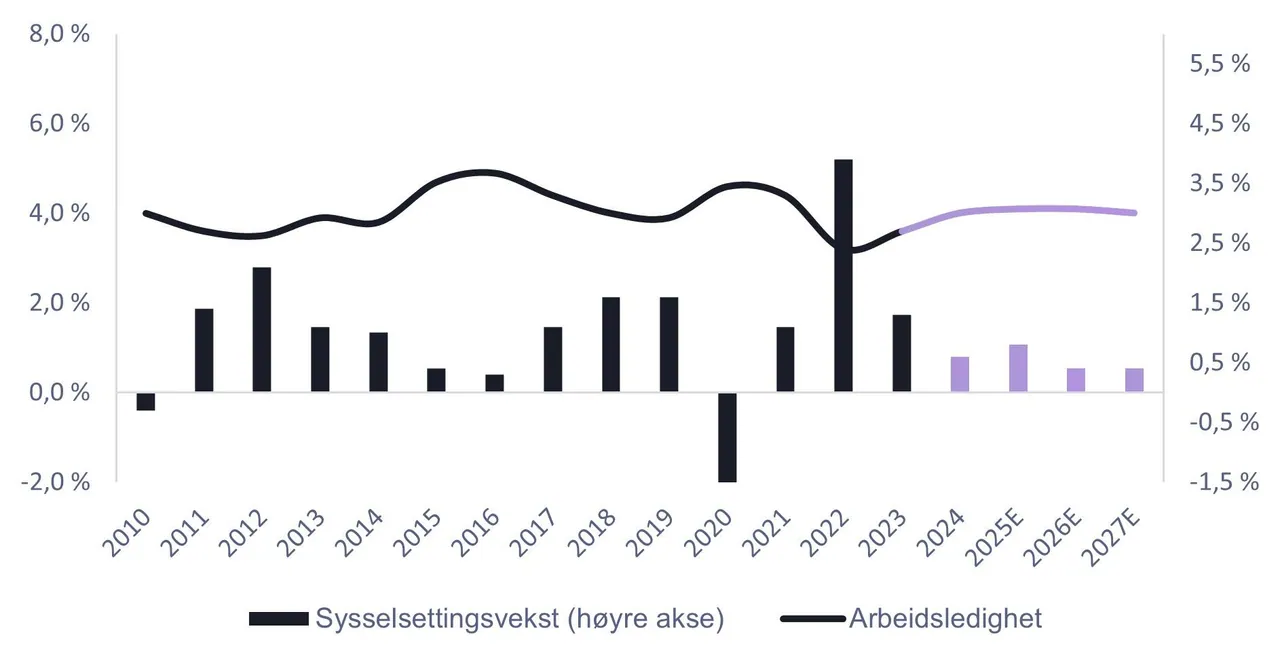
- Unemployment (LFS) has stabilised at a level of around 4.0 per cent and is expected to remain stable over the next few years.
- After a period of varying employment growth over the last five years, relatively stable growth of around 1.0 per cent is expected in the years ahead.
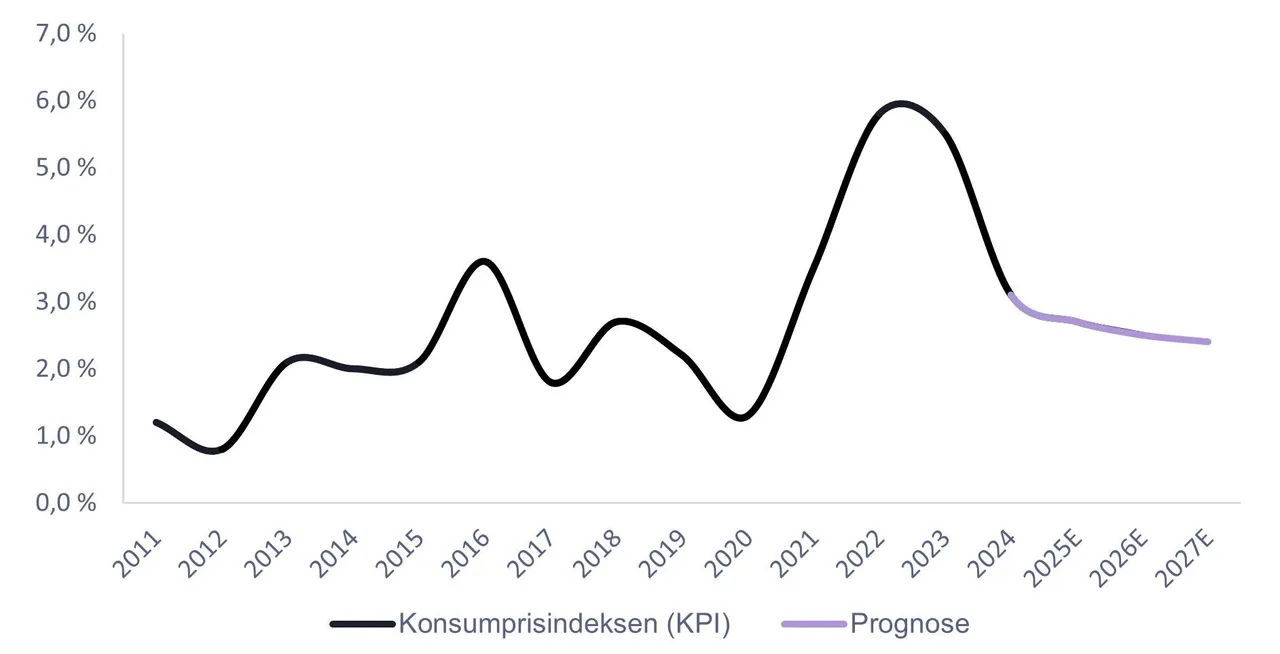
- With expected nominal wage growth for 2024 of 5.3 per cent and inflation of 3.1 per cent, real wage growth is in prospect after several years of negative and flat growth.
CPI
- Twelve-month growth in the consumer price index came in at 2.2 per cent in December, 60 basis points lower than Norges Bank's estimate in Monetary Policy Report 4/2024.
- Lower growth in electricity prices pulled inflation down, while price growth for imported goods has fallen through the year.
- Inflation adjusted for tax changes and excluding energy products (CPI-ATE) continued its downward trend in December, coming in at 2.7 per cent, 10 basis points lower than Norges Bank had estimated.
- Going forward, Statistics Norway expects annual CPI growth to continue moving down towards the 2.0 per cent inflation target.
The interest rate market
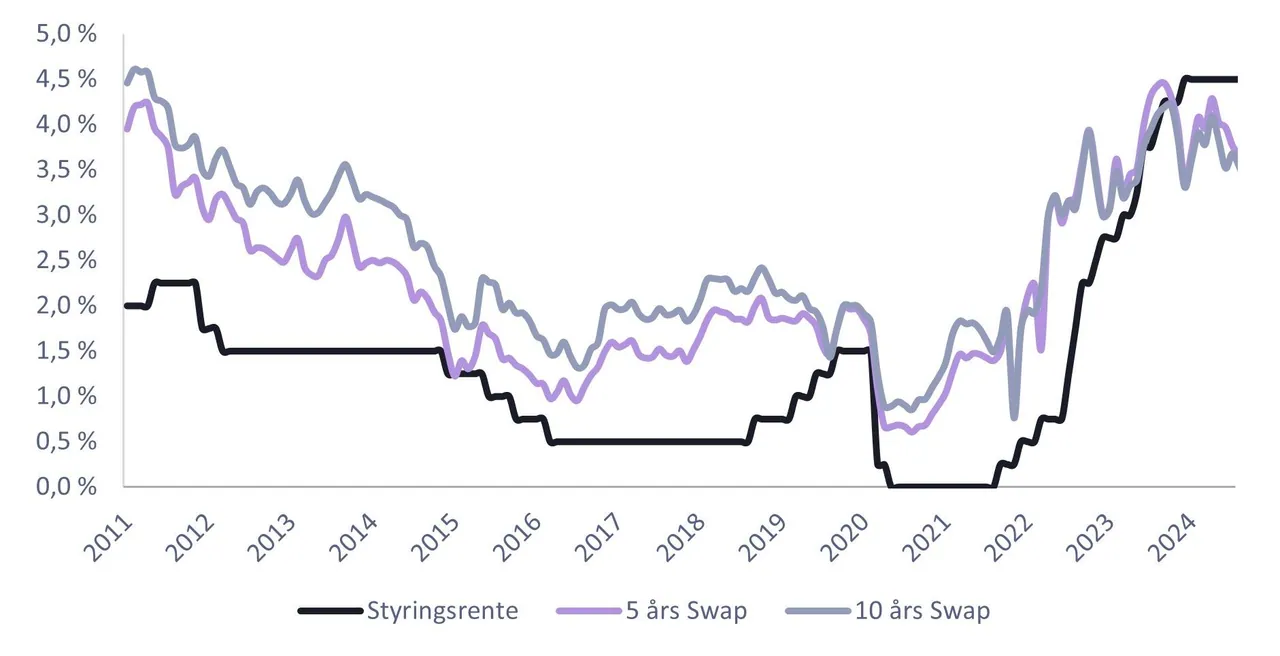
- The policy rate was held unchanged at 4.5 per cent following Norges Bank's rate meeting in December 2024.
- The rate path is kept more or less unchanged, but indicates a somewhat more gradual decline in interest rates in the years ahead than previously estimated. The first rate cut is expected in March 2025.
- The 5-year swap rate has fluctuated between 3.75 and 4.2 per cent during the final quarter of the year, reflecting an increase from the third quarter. The increase is driven partly by expectations of fewer rate cuts in the USA than previously assumed, as well as core inflation coming in somewhat higher than expected for November.