
Charts are reproduced from the original Norwegian report.
Lower growth in the mainland economy ahead
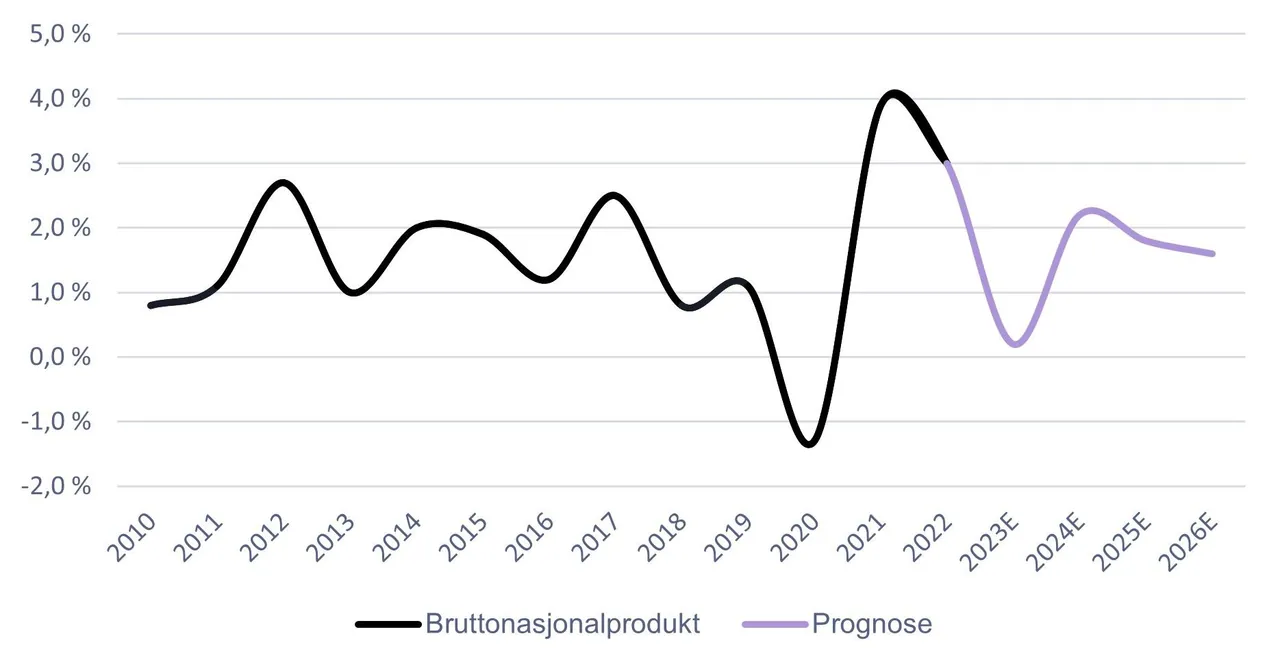
2023, like its predecessors, has been characterised by considerable macroeconomic uncertainty and volatility. High consumer price inflation dominated the macroeconomic picture through both 2022 and 2023, but following monetary tightening, inflation has finally eased both at home and abroad. As a consequence of sharp interest rate increases and high price growth, international growth has also slowed considerably, and developments in 2024 are expected to be relatively weak. However, interest rates appear to have peaked in the EU and the US, and the Federal Reserve has signalled three rate cuts in 2024.
In Norway, too, interest rates have probably peaked. Underlying inflation is easing but remains high. Wage growth is set to be high, and a persistently weak krone means greater inflationary pressure than abroad. For this reason, the policy rate will probably have to be kept higher than among our trading partners, as wider interest rate differentials against other countries usually help to strengthen the krone. Pressure in the labour market remains relatively high, but it is easing and unemployment is gradually rising.
The policy rate was raised by 1.50 percentage points in 2023, and there is considerable uncertainty about how households and businesses will adapt to the large price increases and the rapid rise in interest rates we have seen, according to Norges Bank. The slowdown in the Norwegian economy is expected to continue, and businesses in Norges Bank's Regional Network expect an overall decline in activity in the first quarter of 2024. It is nevertheless stressed that there are large differences between industries.
On the one hand, residential construction has come to an abrupt halt, and residential investment is expected to have fallen by more than 30 per cent in 2023, according to Statistics Norway. Residential investment accounts for around 20 per cent of all mainland investment, and such a large fall has never been recorded before. This development means that more people will become unemployed in construction and will lead to higher unemployment going forward. On the other hand, high petroleum investment and continued growth in exports will help to keep activity in the Norwegian economy up in 2024. Even so, Statistics Norway has once again revised down its forecasts for annual mainland GDP growth and now projects growth of 0.7 per cent in 2023. The growth forecast for 2024 has also been revised down considerably and is expected to end at 0.9 per cent, down 0.8 percentage points from the previous forecast. Only in 2025 and 2026 will growth in labour productivity pick up again, and Statistics Norway expects a return to trend level in 2026.
The labour market – wage growth accelerating for new hires
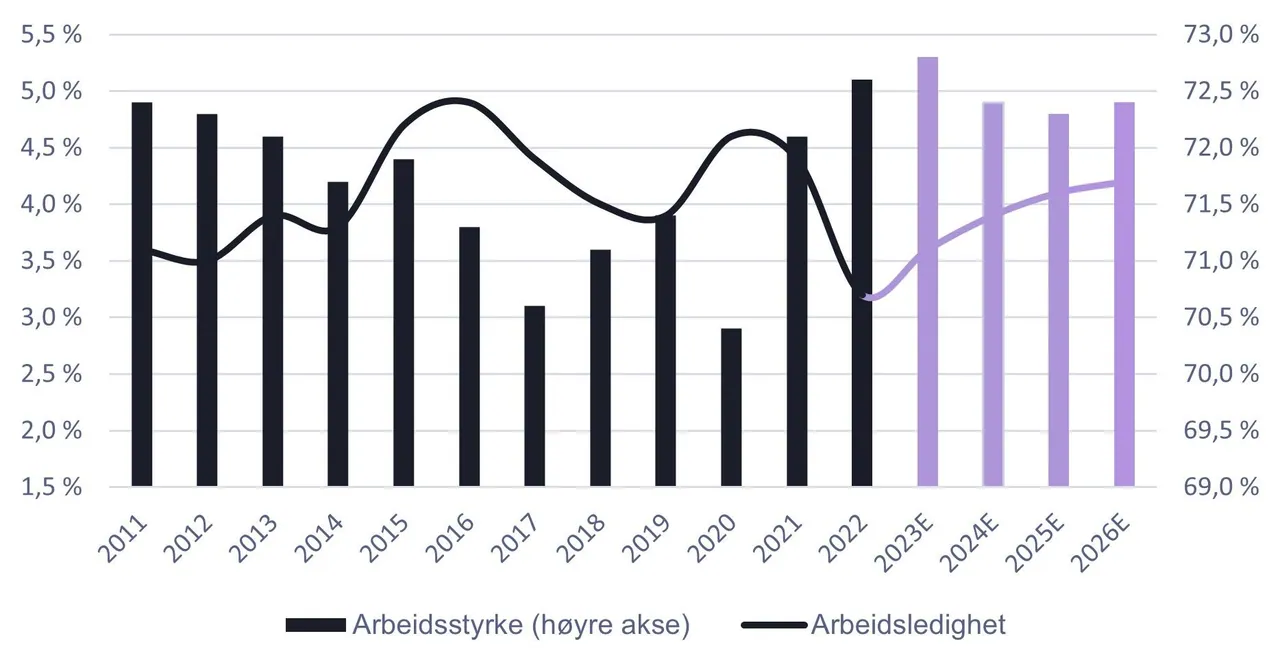
Although unemployment in Norway has risen somewhat over the year, it remains at a low level. In November 2023, unemployment was 3.7 per cent (LFS), 0.3 percentage points higher than at the beginning of the year. This corresponds to 110,000 unemployed people. The seasonally adjusted three-month moving average for September and October showed a corresponding increase to 3.6 per cent from 3.4 per cent in the previous three-month period. After a period of broadly unchanged unemployment, there has been a steady and slight increase since the summer, according to Statistics Norway. Nevertheless, unemployment in October 2023 was lower than at any point in the period from November 2012 to October 2021.
According to Statistics Norway, the main explanation for the rise in unemployment is that more people who were previously outside the labour force have now started looking for work. At the same time, the number of vacancies remains at a stable, high level, indicating that the labour market is still tight. This in turn may help push wage growth up further.
For newly hired employees, average agreed monthly earnings in the second and third quarters of 2023 were 6.6 and 7.1 per cent higher respectively than earnings for newly hired employees in the corresponding quarters of the previous year. Historically, new hires have tended to pull average agreed monthly earnings down, but the figures suggest that wage growth has also accelerated for this group.
Following the wage growth figures for the third quarter of 2023 and an apparently persistently tight labour market, Statistics Norway has revised up its estimate for annual wage growth in 2023 from 5.5 per cent in the previous economic report to 5.6 per cent. Despite the upward revision, annual CPI growth of 5.5 per cent means there is only barely real wage growth in 2023. Towards 2026, Statistics Norway expects CPI growth to slow while nominal wage growth holds up. Real wage growth will thus pick up and be positive from 2024 to 2026.
Record-high annual growth in core inflation
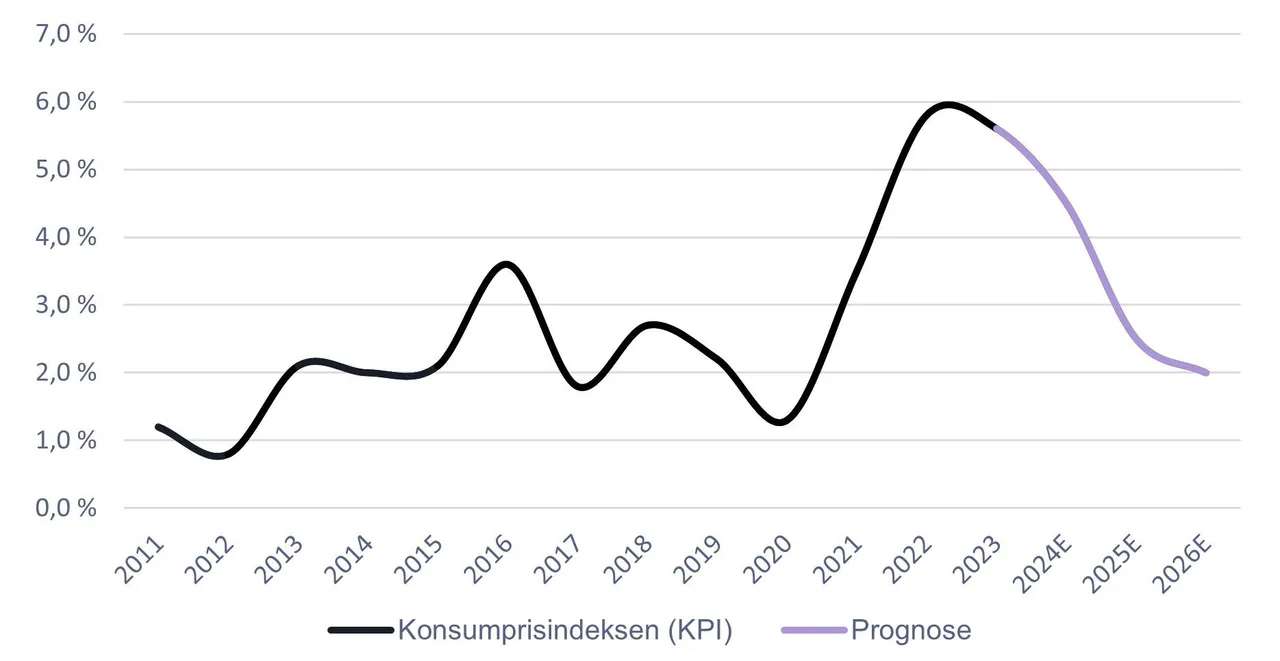
After four months of falling CPI growth, it picked up somewhat in the fourth quarter. Inflation, as measured by the CPI, rose by 4.8 per cent from December 2022 to December 2023. Twelve-month growth increased in both October and November, while in December it was the same as in November. Despite somewhat higher inflation in the fourth quarter, it is still slightly lower than Norges Bank has assumed in its forecasts, and the trend is downward.
CPI-ATE rose by 0.2 per cent from November to December. This is somewhat lower than the monthly change in the same period the previous year, which pulls twelve-month growth down from November. In November it was 5.8 per cent, while in December it was 5.5 per cent. Annual growth, corresponding to the average over the twelve months of the year, ended at 5.5 per cent for the CPI and 6.2 per cent for CPI-ATE. According to Statistics Norway, annual growth in CPI-ATE is the highest ever recorded for this index.
In the third quarter it was electricity prices in particular that pulled inflation down, but an exceptionally cold November led to a rebound in electricity consumption and electricity prices in the fourth quarter. According to Statistics Norway, electricity prices including grid tariffs rose by 18.4 per cent from September to October and by 24.7 per cent from October to November. Despite sharp increases in electricity prices in both October and November, they fell in December and were significantly lower in the fourth quarter of 2023 than in 2022.
With the exception of electricity prices, certain promotional campaigns around Black Friday and Christmas offers on some food items, price developments were relatively similar to the same period the previous year. It is still the price of actual rents and food that is contributing to persistently high core inflation, despite a fall in the price of food and non-alcoholic beverages from November to December.
Twelve-month growth in actual rents was 4.4 per cent higher in December than at the same time last year. According to Statistics Norway, this is unusually strong growth, explained by the fact that many leases have had their rent adjusted upwards in line with high CPI growth, and that higher interest costs are pushing rents up. In addition, municipal water and sewerage charges are expected to rise significantly in 2024 as well, owing to higher interest and capital costs. With higher interest rates, strong population growth and high demand for rental housing, Statistics Norway assumes that rent inflation will also be relatively high in 2024.
Food prices fell by 2.0 per cent from November to December but are 8.9 per cent higher than at the same time last year. Within the food category, fruit and vegetables and fish have again risen the most this year. The price increase is partly related to the weakening of the krone, as Norway's food self-sufficiency rate is just under 50 per cent, according to the Norwegian Institute of Bioeconomy Research. This results in significant food imports, and Statistics Norway expects price growth to be high in 2024 as well.
Since the previous economic report, Statistics Norway has revised up its forecasts for both the CPI and CPI-ATE in 2024 by 0.5 percentage points. The upward revision is based in particular on a renewed weakening of the krone, as well as on wage growth and electricity prices for businesses being higher than previously estimated. Growth in both the CPI and CPI-ATE is projected at 4.5 per cent from 2023 to 2024, significantly down from this year's estimates of 5.6 and 6.3 per cent respectively. Thereafter, the pace of growth will gradually slow to 2.0 per cent and 2.3 per cent in 2026.
Has the policy rate finally peaked?
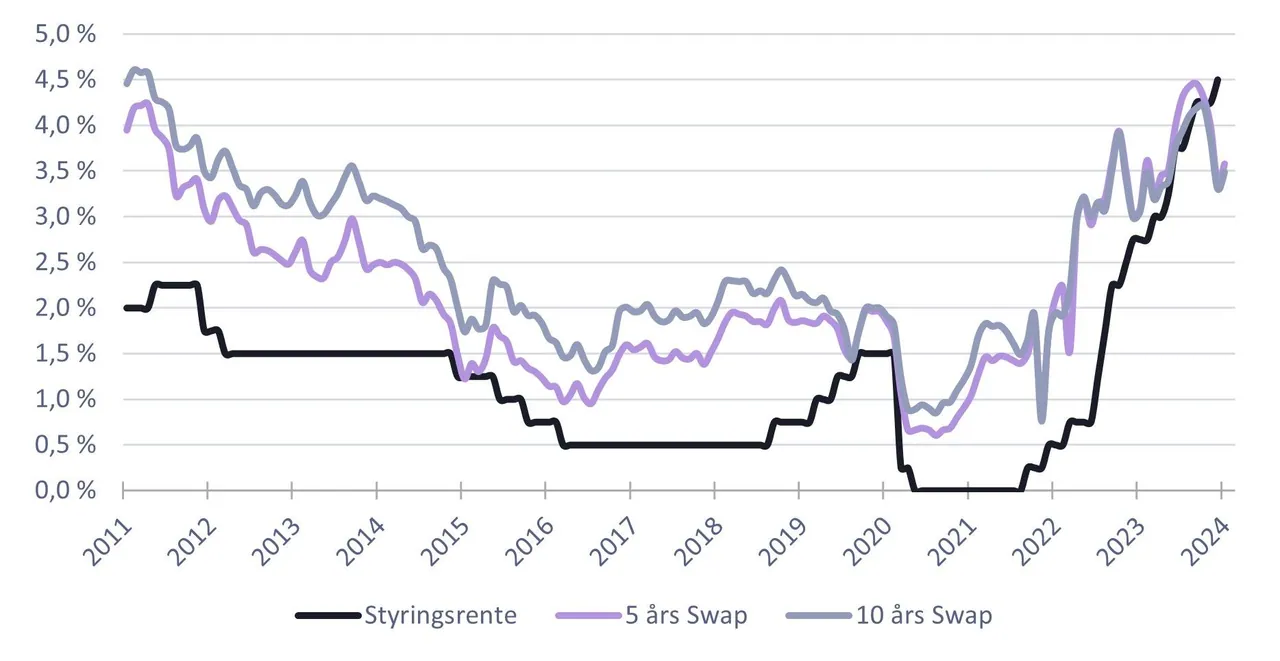
In line with Norges Bank's projections in September, the policy rate was raised to 4.50 per cent in December – contrary to what market expectations for the policy rate implied. Although inflation has eased and the economy is cooling, concern about price growth once again weighed most heavily in the rate decision. The decision placed particular emphasis on the further weakening of the krone, which makes it more difficult to bring price growth down. At the same time, business costs have risen sharply in recent years, and wage growth looks set to remain high. Norges Bank believes this will keep price growth up going forward, even though price impulses from abroad are easing. It stresses that high and variable price growth carries significant costs for society and hits those with the lowest incomes particularly hard. The rate increase in December did, however, have an immediate positive effect on the krone exchange rate, and the krone has strengthened against both the dollar and the euro since then.
Norges Bank believes the policy rate is now close to the level needed to bring price growth down to the target within a reasonable time horizon. It considers that the current level strikes the best possible balance between ensuring low and stable inflation and stable economic developments, even though the full effect of the most recent rate hikes has not yet been seen. The policy rate forecasts are relatively similar to those in September, and the rate is expected to be kept up for some time to come. When price growth comes down, and the economy warrants it, the rate will be reduced. Norges Bank estimates that this will not be the case until autumn 2024, and that the rate will be reduced gradually from then on.
The rate hike in September and Norges Bank's policy rate forecasts run counter to what the market expected and expects going forward. First and foremost, the market-implied probability that the policy rate would be held unchanged in December was 86 per cent. Looking ahead, the vast majority also expect the first rate cut to come as early as March, and the rate to be cut considerably more often in 2024 than the single cut Norges Bank projects. The main reason why policy rate expectations deviate so much from Norges Bank's projections is differing views on the outlook for the Norwegian economy. In particular, after the figures in the Regional Network report indicated a decline in activity from the first quarter of 2024, many expected an unchanged policy rate in December.
Five- and ten-year swap rates fell significantly in the fourth quarter, largely as a consequence of weaker key figures from the US economy. Developments in swap rates in Norway have largely followed developments in corresponding rates abroad. At the time of writing they are around 0.7–0.8 percentage points below their peak, and the five-year swap rate stood at 3.58 per cent as of 10 January, while the ten-year swap rate was 3.49 per cent. At the start of 2024, however, long-term rates have risen again, but they remain at a lower level than previously. In contrast to long-term rates, short-term rates held up in the fourth quarter.
The property market
Lowest transaction volume in many years
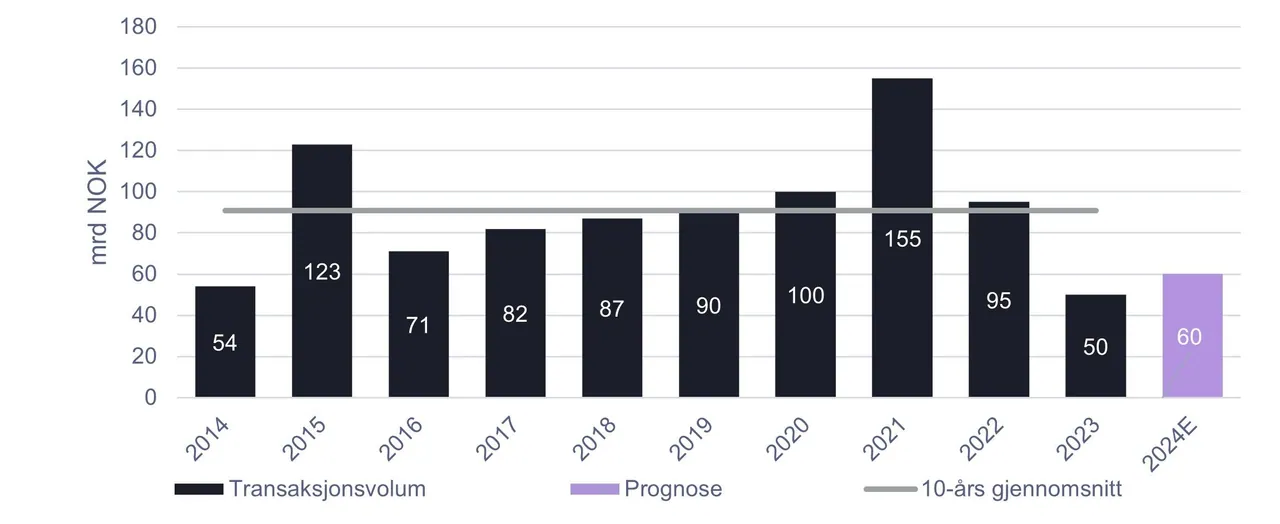
Transaction volume in the fourth quarter ended at approximately NOK 14 bn, spread across 39 transactions. Total transaction volume for 2023 is estimated at around NOK 50 bn, down almost 50 per cent from 2022. This is the lowest transaction volume in many years, and a development few foresaw at the start of 2023. Viewed in real terms (adjusted for inflation), the picture looks even bleaker. The development also stands out when looking at transaction volume in December. Historically, the final month of the year has been one of the months with the highest transaction volume, but that has not been the case this year. By comparison, transaction volume in December of the record year 2021 was over NOK 25 bn, almost four times as high as in December 2023.
The low transaction volume in 2023 was largely related to higher financing costs, falling property values and macroeconomic uncertainty. The banks have imposed higher equity requirements and raised debt-servicing requirements, while bank margins increased through 2023. The consequence is property players adopting a wait-and-see approach, with several looking towards 2024 before taking any action.
Many of the transactions being completed, or properties for sale in today's market, are forced by situations in which owners need to strengthen their liquidity. In most cases this is either in connection with refinancing existing loans, to avoid breaching loan covenants, or to maintain a credit rating. Such a situation arose in October, when an Arctic syndicate sold Telegrafen in Oslo to Norwegian Property for just over NOK 1.6 bn. The transaction was one of the largest in 2023 and was concluded at a yield significantly above the 3.45 per cent yield Arctic paid back in 2020.
On the positive side, long-term rates have fallen significantly since their peak in the third quarter, and the spread between prime yield and the ten-year swap rate is approaching a "normal" level. Historically, the so-called yield gap has been around 1.70–1.80 percentage points, and at the time of writing it is 1.26 percentage points, assuming a prime yield of 4.75 per cent. The gap is still too narrow in today's market, which is pushing yields upwards. We nevertheless see that property values have come down and that the gap between buyers' and sellers' price expectations is narrowing. This could push transaction volume up in 2024, thereby providing more and better reference points in the market. In addition, Norges Bank indicates that interest rates have probably peaked, which could provide greater predictability. This could contribute to positive sentiment in the market, and to 2024, unlike 2023, being a year with somewhat greater certainty about the future.
Despite some distressed sales, the commercial property market appears relatively robust, according to Norges Bank. It believes most companies will be able to handle higher interest costs, particularly as a result of higher rents. At the same time, it stresses that if both rental income and property prices fall markedly, many companies will have difficulty servicing their debt. 2024 nevertheless offers cautious optimism, and we expect transaction activity in 2024 to be somewhat higher than in 2023. For some, 2024 will offer good opportunities, while for others it may prove very challenging. In a historical perspective, however, volume for 2024 is expected to be relatively low.
The office market – another sharp CPI adjustment this year
The Oslo office market still appears relatively strong, and in 2024 existing leases will again see a high rent adjustment as a result of high inflation in 2023. Inflation figures for both October and November are relevant for property players, as in the vast majority of leases they determine the rent adjustment for the coming year. The standard is for leases to be indexed on 1 January each year based on November inflation. In 2021, November inflation was 5.1 per cent, while in 2022 and 2023 it was 6.5 and 4.8 per cent respectively. In other words, rents under existing leases have increased by around 11.6 per cent over the past two years and 17.3 per cent over the past three years. By comparison, existing leases have been inflation-adjusted more over the past three years than over the preceding seven years combined.
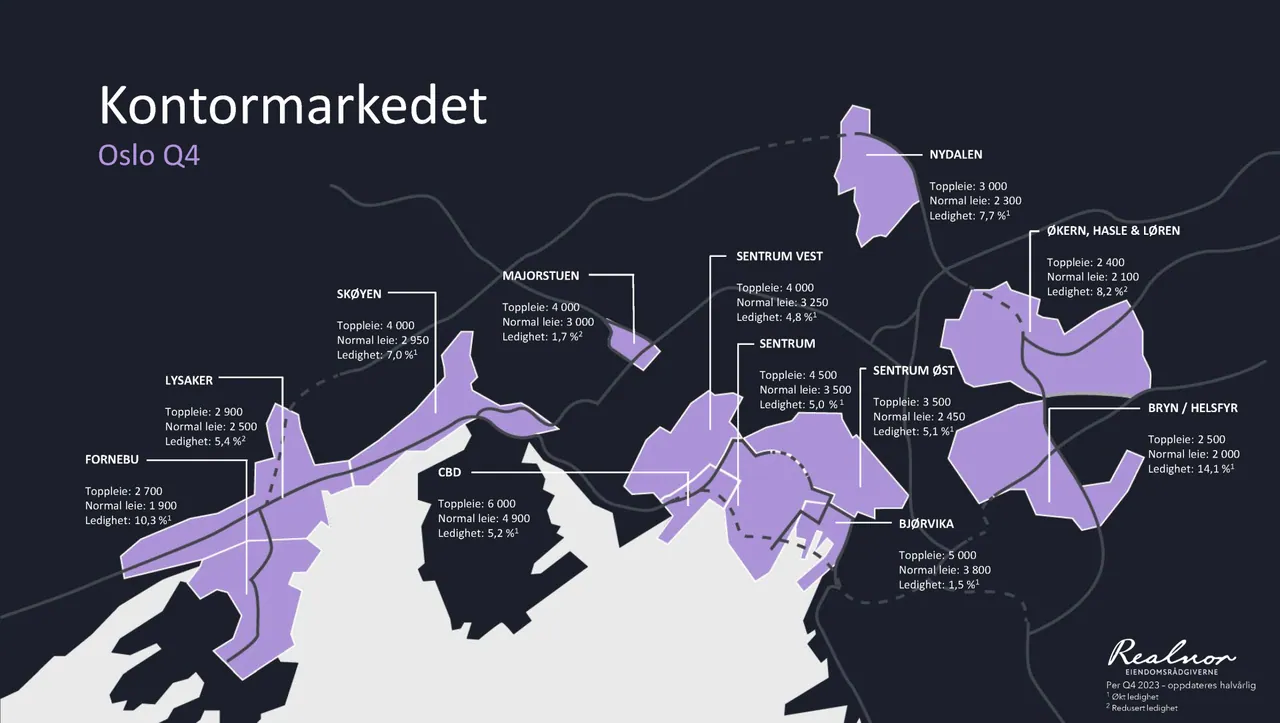
Office vacancy in Oslo (incl. Lysaker and Fornebu) increased gradually in the fourth quarter. Since January 2023, vacancy has risen by 0.6 percentage points, and in December the six-month rolling vacancy rate was 6.4 per cent. The rise in vacancy is partly due to certain "coincidences", with several refurbishment projects and new buildings coming onto the market at the same time, while demand and rental growth have eased somewhat.
As we see it, however, the office market still appears relatively solid, and we see no sharp slowdown in demand for office space. This is underpinned by high employment, which contributes positively to demand for office space, and by signing volumes indicating good activity in the office market. Consequently, rents are expected to remain stable, despite strong rental growth in recent years. Rental growth will, however, be more subdued than in previous years.
The logistics market – high construction costs put pressure on rents
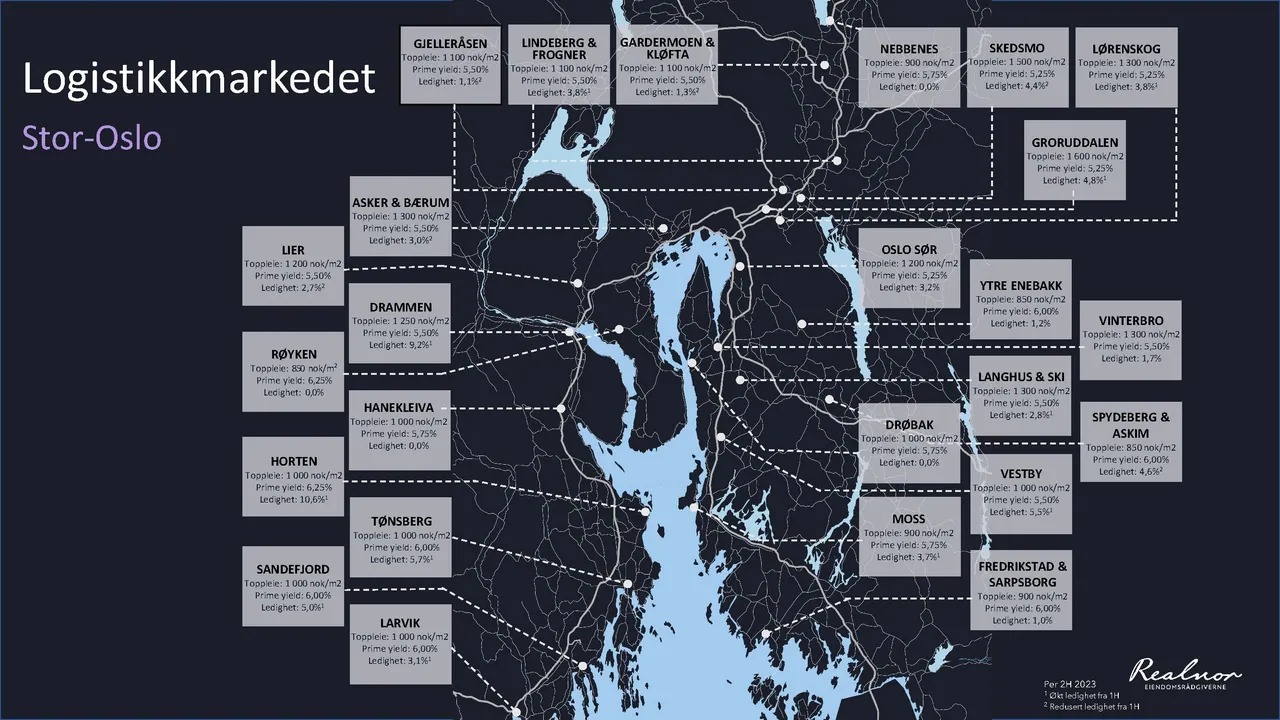
In the logistics market, demand remains strong and vacancy remains low in Greater Oslo. Higher construction costs have meant that some projects are not viable at current rents. At the same time, required returns have risen, and for many who have bought development property in recent years, today's calculations look very different from those at the time of purchase. This puts pressure on rents and is particularly evident in areas further out along the transport corridors, where rents have not risen as much as in the most central areas. At the same time, there is relatively good availability in some of these areas, for example at Gardermoen and at Oslo Logistikkpark Drøbak. Several new projects are nevertheless being carried out, but these leases are often characterised by large, solid occupiers on long leases.
Activity in the transaction market has been relatively low throughout the year. In 2023, transaction volume for logistics and industrial property was approximately NOK 8.7 bn, accounting for around 18 per cent of total transaction volume. The share of total volume does not differ significantly from previous years, but the bulk of transaction volume comes from a few large transactions. Four of a total of 21 transactions in 2023 accounted for 75 per cent of volume, and the vast majority of transactions in 2023 were between NOK 50 m and NOK 200 m. The same trend was also seen in the fourth quarter, when the US-based TIAA acquired the self-storage company Self Storage Group. The transaction is estimated to account for as much as 70 per cent of the total volume of NOK 3.2 bn in the fourth quarter.
The retail market
Shopping centres keep their heads above water and deliver surprisingly well
With 11 of 12 months "counted", shopping centres appear to have come through 2023 relatively well. According to Kvarud Analyse, they have increased sales by 4.6 per cent. Sales also rose in November and were 4.8 per cent higher than in 2022. This is an increase of 22 per cent from October, the highest ever measured since the shopping centre index was established. Much of the reason relates to Black Week, which accounted for almost 30 per cent of November's monthly sales. Of the shopping centre chains that have reported sales figures for 2023, all have delivered above the industry's expected annual growth (3.9 per cent as of November).
Across the various segments, restaurants and cafés and service businesses are still performing best. They have increased sales by 8.7 per cent compared with the same period in 2022. Despite a relatively good year so far for shopping centres, sales growth has largely been price-driven. This is despite visitor numbers having increased by 5.5 per cent.
Retail trade – large differences between sectors
After three months of decline, retail sales rose somewhat surprisingly in both October and November, according to seasonally adjusted figures from Statistics Norway. For the period September to November 2023, there was nevertheless a decline of 0.4 per cent compared with the previous three-month period, and the trend remains negative. In the first eleven months of 2023, sales rose by 3.2 per cent, or by approximately NOK 15 bn excluding VAT. Grocery and convenience stores have accounted for most of the increase in kroner terms. At the same time, sales in Norwegian online stores have risen the most in percentage terms, with growth of 6.2 per cent over the same period. By comparison, in-store retail rose by 2.9 per cent over the corresponding period.
Although much of the sales growth across sectors is price-driven, things have gone better than feared for many. That said, there is still considerable uncertainty, and developments vary greatly across segments. The food service industry, for example, has increased its sales sharply this year, and since food service is a service, this largely explains the shift in consumption from goods towards services. Nevertheless, the number of food service bankruptcies rose by 26 per cent in 2023 compared with 2022. A cautionary example is the bankruptcy of the nightlife group Flott Gjort. As a result of the bankruptcy, 20 different restaurants and bars face possible closure.
In contrast to the food service industry, sales in "home and interiors" have fallen sharply in 2023. It is clear that durable goods are being deprioritised by Norwegian consumers, while services are prioritised in tighter economic times. This trend is expected to become even more pronounced, and there will be large differences between different players and sectors in 2024.
The hotel market – almost back to 2019 levels
The hotel market went through some very challenging years during the pandemic but has since developed positively. Hotel occupancy remains relatively stable compared with the years before the pandemic. According to Benchmarking Alliance, the occupancy rate in 2023 was 58.5 per cent – somewhat lower than the 2019 level of 60.4 per cent. Among the major cities, Oslo and Bergen have the highest occupancy, while Bodø has experienced the highest growth in the number of rooms sold. Since 2019, 29.9 per cent more hotel rooms have been sold in Bodø.
It is above all hotel room rates that have driven growth in the hotel market, with prices up 8.2 per cent from September 2022 to September 2023 and 31.5 per cent from 2019. RevPAR has also increased by 13.7 per cent from the corresponding period last year and by 27 per cent from 2019. Oslo has the highest RevPAR in the country, averaging NOK 983 in the period January to September 2023.
The development is largely related to general price growth, and to the fact that key input factors such as energy, staff, goods and interest rates have risen sharply in recent years. Higher operating costs are pushing room rates up, in addition to the rise in CPI. Geographically, the development is relatively broad-based, and Oslo still has the highest room occupancy and the highest average room rate. In Oslo, hotel prices have risen by around 40 per cent since summer 2019. By comparison, the consumer price index has risen by 17.5 per cent.
