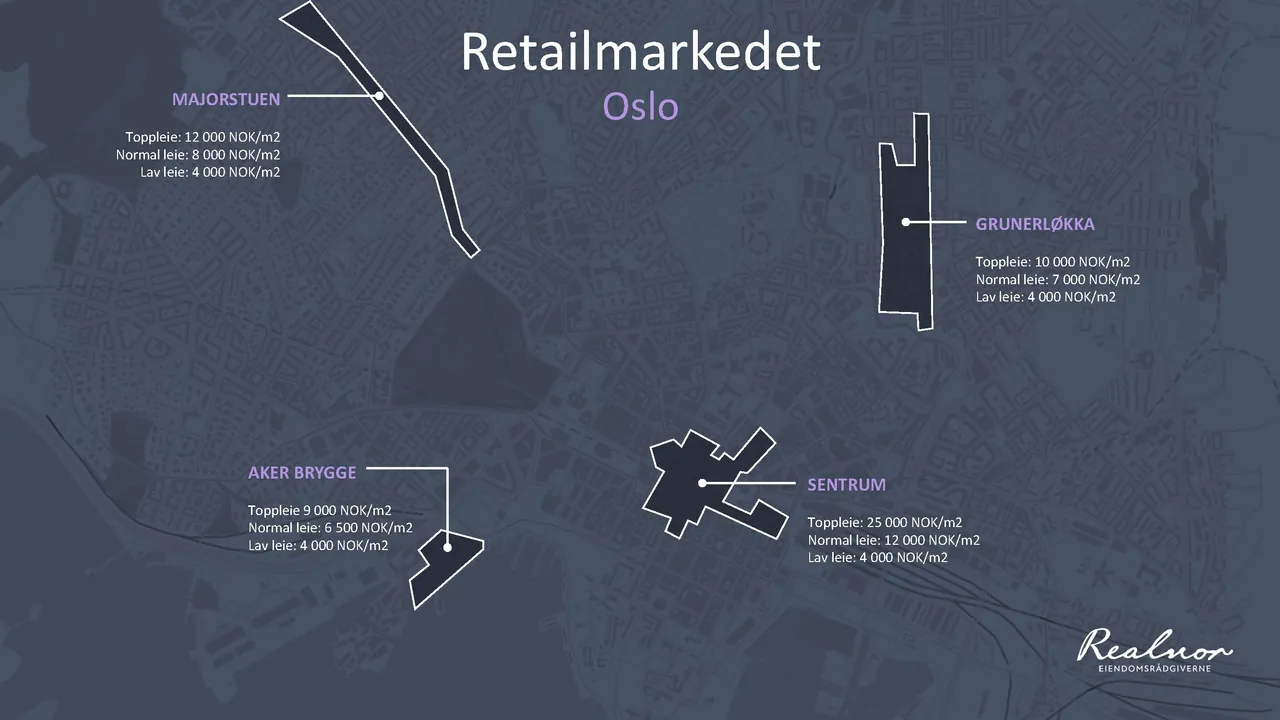
Charts are reproduced from the original Norwegian report.
The property sector adds to economic uncertainty
The macroeconomy remains volatile, and uncertainty is generally high – both nationally and internationally. We keep receiving new activity indicators that give us a basis for forming expectations about the future. Even so, recent years have proven that estimating and predicting the future is a near-impossible task. That said, inflation has eased, and we are expected to be close to the interest-rate peak in Norway, the US and the eurozone. This may bring some long-awaited predictability. At the same time, international growth forecasts are being revised down, the labour market is showing some signs of weakness, and there is particular suspense around how strongly the rate rises in the US, the eurozone and Norway will affect the economy. Unemployment is a lagging indicator of the business cycle, and many recessions have begun when unemployment was unusually low. Central banks therefore still face conflicting considerations in setting rates, and some have asked whether they have more objectives than instruments.
Since last quarter, developments in the world's second-largest economy, China, have added further uncertainty. China is the engine of the global economy, and many activity indicators have been considerably weaker than expected. The property sector, which accounts for more than a quarter of China's economic activity, is especially vulnerable and needs a strong policy response and government support to stabilise. At the same time, economic growth is lower than assumed, consumption and private investment are disappointing and exports are falling. This led to deflation in July, and demand has long been stagnant. In August prices rose again, but the economy is generally on a downward path and uncertainty is high. This has significant knock-on effects, and the European economy is feeling the slowdown in the "world's factory".
The US commercial property market is also experiencing problems. Office values are falling sharply in many parts of the US, and many property owners are struggling to service their debt. Nevertheless, inflation has fallen considerably, and the rate peak is apparently not far off. The same applies in the eurozone, where inflation is falling and the European Central Bank has signalled that the rate peak has been reached. In September it raised rates for the tenth consecutive time, to 4.0 per cent, the highest level ever. Inflation is expected to ease considerably in 2024 and 2025 as a result of higher interest rates.
In Norway, the trend is relatively similar to that in the eurozone. Interest rates have risen sharply in a short space of time and inflation is falling. The policy rate was raised further in September, and the interest burden for households will be as high as in the 1990s. Statistics Norway (SSB) estimates that interest expenses after tax will amount to around 8–9.5 per cent of households' disposable income. By comparison, the average annual interest burden was 5.5 per cent in the ten-year period 2010–2019. It is relatively indisputable that consumption will fall, and SSB has revised down its annual consumption forecast by 1.5 percentage points since last quarter. In addition, the effect of the rate rises is expected to become more evident going forward, as the effect comes with a time lag. The housing market will be particularly hard hit by higher rates, and sales and starts of new homes have already plummeted. According to Prognosesenteret, the number of new homes sold in the third quarter of 2023 was 27 per cent lower than in the third quarter of 2022. At the same time, new housing starts in the third quarter were 50 per cent lower than last year, the lowest level recorded since 1999.
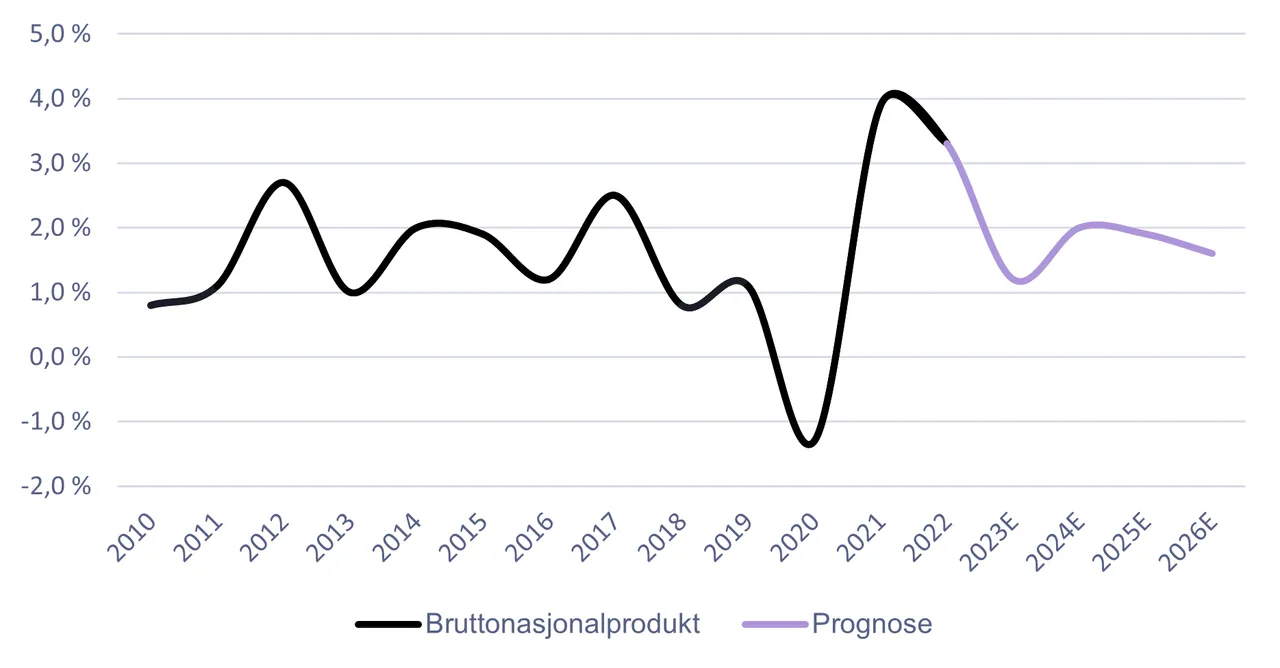
Growth in the Norwegian economy has slowed, despite mainland GDP growth of 0.2 per cent from June to July. SSB has once again revised down its forecasts for mainland GDP in 2023 and now expects annual growth of around 1 per cent. The downward revision is driven in particular by an expected further fall in residential investment, which is likely to reduce activity in the construction sector. In 2024, SSB expects growth to pick up again, before rising further to approx. 2.0 per cent in 2025 and 2026.
Weak new-build housing market affects unemployment in the construction sector
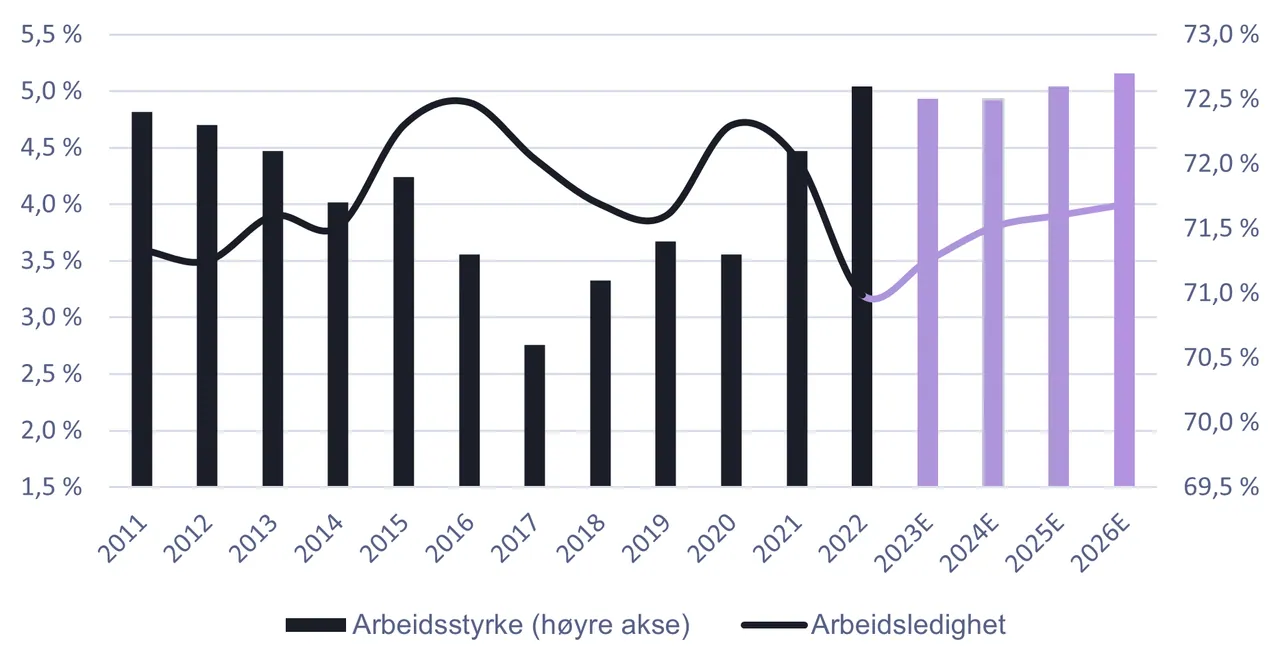
The Norwegian labour market remains stable and unemployment is low in a historical perspective. In September, unemployment was unchanged at 3.5 per cent (Labour Force Survey), roughly the same level as throughout the year. Furthermore, the seasonally adjusted three-month moving average for August shows an increase from 3.5 per cent to 3.6 per cent. According to SSB, there are therefore few indications that pressure in the labour market is easing.
NAV also reports a stable labour market, but with unemployment rising slowly. In August there were 54,600 people wholly unemployed, equivalent to 1.9 per cent of the labour force. The number of jobseekers registered with NAV also remained stable in September. Since the turn of the year, the number of wholly unemployed and jobseekers on labour market schemes has increased by 8,400 people, and cyclically sensitive industries are particularly exposed. The construction sector, for example, has seen negative developments this year, which must be viewed in the context of falling residential investment and developments in the new-build housing market.
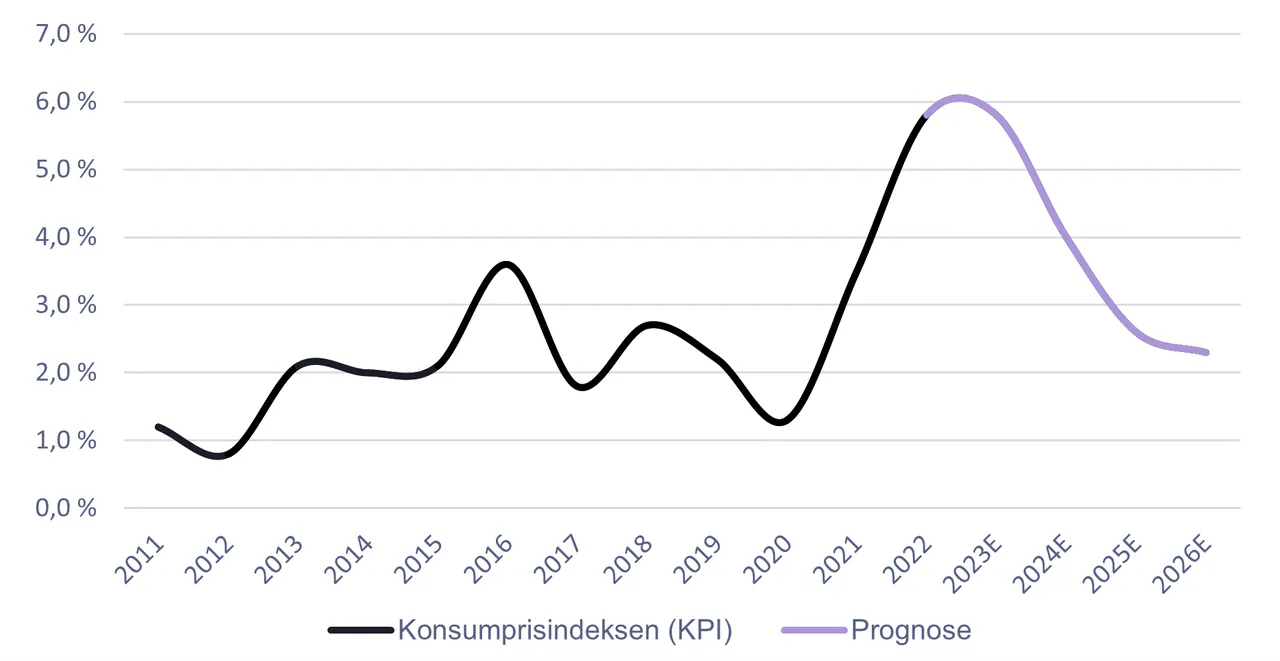
SSB has again revised up annual wage growth from 5.3 per cent to 5.5 per cent. It still expects a decline in real wages in 2023, as a result of CPI growth of 5.8 per cent. Towards 2026, inflation is expected to ease and real wage growth to pick up somewhat.
Lowest inflation in over a year
Inflation, measured by the CPI, rose 3.3 per cent year on year in September, a significant downside surprise (4.0 per cent was expected). Price growth has now fallen for four consecutive months and, as of September, is at its lowest level since May last year. From August to September it fell by 1.5 percentage points, with electricity and food prices in particular pulling inflation down. The price of electricity including grid charges fell by 16.1 per cent from August to September, whereas last year prices rose 10.5 per cent over the same period. Compared with September last year, the price was 43.9 per cent lower this year. The fall in electricity prices is explained by, among other things, high levels of rainfall and wind, high reservoir levels and high power production. Household electricity prices are expected to continue in the same direction going forward, but will depend in particular on the amount of precipitation this winter.
Furthermore, the unusually strong growth in food prices in the second quarter has so far eased in the third quarter, and there are signs that food price growth is levelling off. Nevertheless, food prices in August were 9.3 per cent higher than a year earlier, driven strongly by price growth for fruit, vegetables, bread and meat. In September food prices fell by 1.5 per cent from August, which is a normal seasonal pattern.
CPI-ATE rose 5.7 per cent from September 2022 to September 2023, a fall of 0.6 percentage points from August. The difference between CPI and CPI-ATE is largely due to electricity not being included in CPI-ATE. Twelve-month growth in CPI-ATE is well above the CPI, and price growth remains broad-based, with most goods and services increasing in price. In addition to the food prices mentioned above, rents in particular contribute to high growth in CPI-ATE. Rents were 4.1 per cent higher in September this year than at the same time last year. According to SSB, CPI-ATE will remain somewhat higher than the CPI going forward as well. It has once again revised up its annual forecasts for both CPI and CPI-ATE, which are expected to end at 5.8 and 6.3 per cent respectively. This is an upward revision of 0.2 and 0.3 per cent since last quarter. In 2024, inflation is expected to ease significantly, with both CPI and CPI-ATE ending at 4.0 per cent. The decline is projected to continue in 2025 and 2026, and SSB estimates that inflation will be around the inflation target in those years.
SSB has also sought to explain the surprisingly high inflation and why there have been such large deviations between its forecasts and actual inflation. It points mainly to two factors: (I) unforeseen changes in international conditions and (II) unforeseen changes in companies' pricing. The former is broken down into three main factors: electricity prices, international prices and the krone exchange rate. According to SSB, the contribution from these three main factors explains most of the unexpected price increase and hence the forecast error. The latter relates to increased mark-ups on both import and domestic market prices. For the higher import prices, SSB points to a weaker krone and high foreign price growth as the main drivers. In the domestic market, companies have raised prices more than production costs would suggest, with manufacturing industries showing the largest increases in mark-ups. The International Monetary Fund has also observed the same tendency in the eurozone. It believes that some of the high inflation is due to companies having increased their margins more than necessary to cover the strong inflation.
Will the rate path turn as early as 2024?
Even though inflation has eased for four consecutive months and fell considerably more than expected in September, Norges Bank raised the policy rate by a further 0.25 percentage points in September. It expects one more rate rise in December and the rate to peak at 4.5 per cent. Norges Bank estimates that the rate will need to be kept elevated for some time to come and that it will remain at 4.5 per cent throughout 2024. This confirmed the speculation from last quarter – that rates will be kept high considerably longer and that rate cuts cannot be expected before 2025. It nevertheless stresses that the future path of the policy rate depends on economic developments, but given the current outlook and risk picture, further tightening is needed.
The rate rise relates to inflation being too high. Inflation has remained higher than Norges Bank expected before the summer, and it also expects inflation to stay higher for longer than previously estimated. According to Norges Bank, persistently high and variable price growth carries large costs – for individuals, for businesses and for society. It does not envisage a sharp slowdown in the Norwegian economy, but expects unemployment to rise somewhat. Wage growth will also remain elevated, but it does not envisage real wage growth until 2024. In any case, it emphasises that the central bank's objective is for inflation to stabilise close to 2 per cent and that monetary policy will be conducted on that basis.
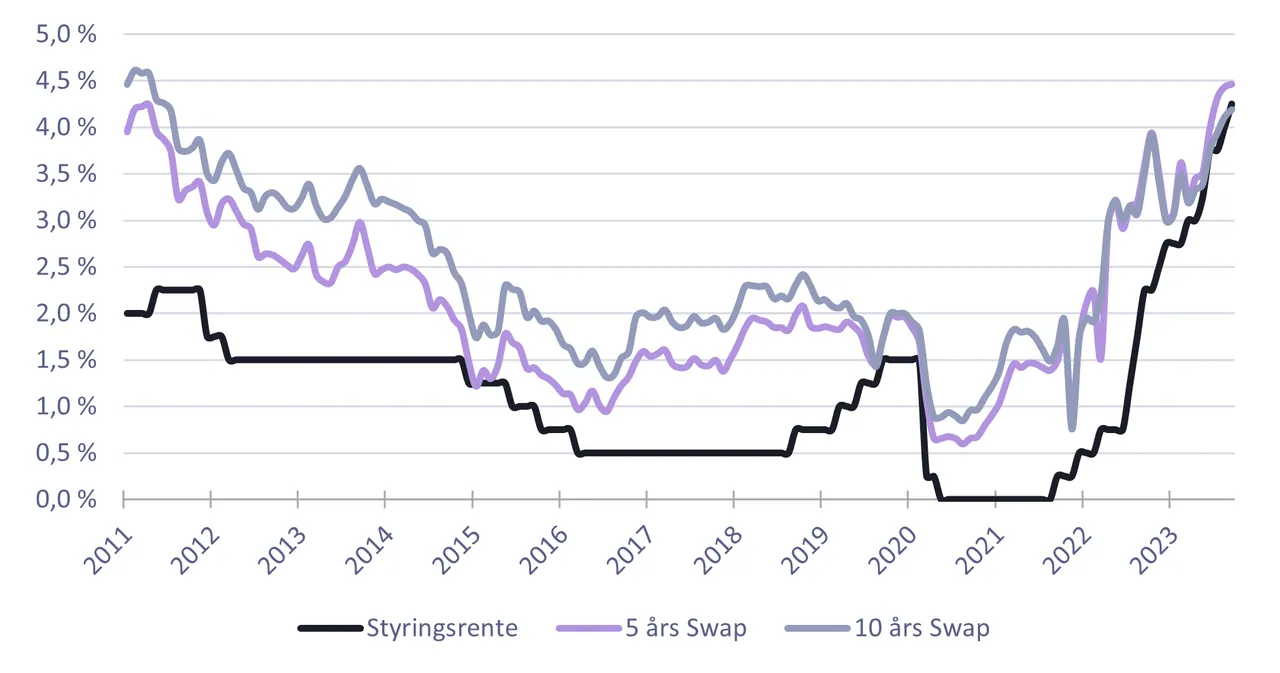
Five- and ten-year swap rates received a further boost when Norges Bank presented its rate decision on 21 September. As of 21 September, they stood at 4.50 and 4.22 per cent respectively. As a result, property financing is becoming increasingly challenging, and UNION's bank survey shows that new property loans at floating rates are above 7 per cent. The survey also shows that banks are more demanding, both in terms of equity requirements and the type of property to be financed.
The property market
The largest transaction of the year, but can the transaction market be given a clean bill of health?
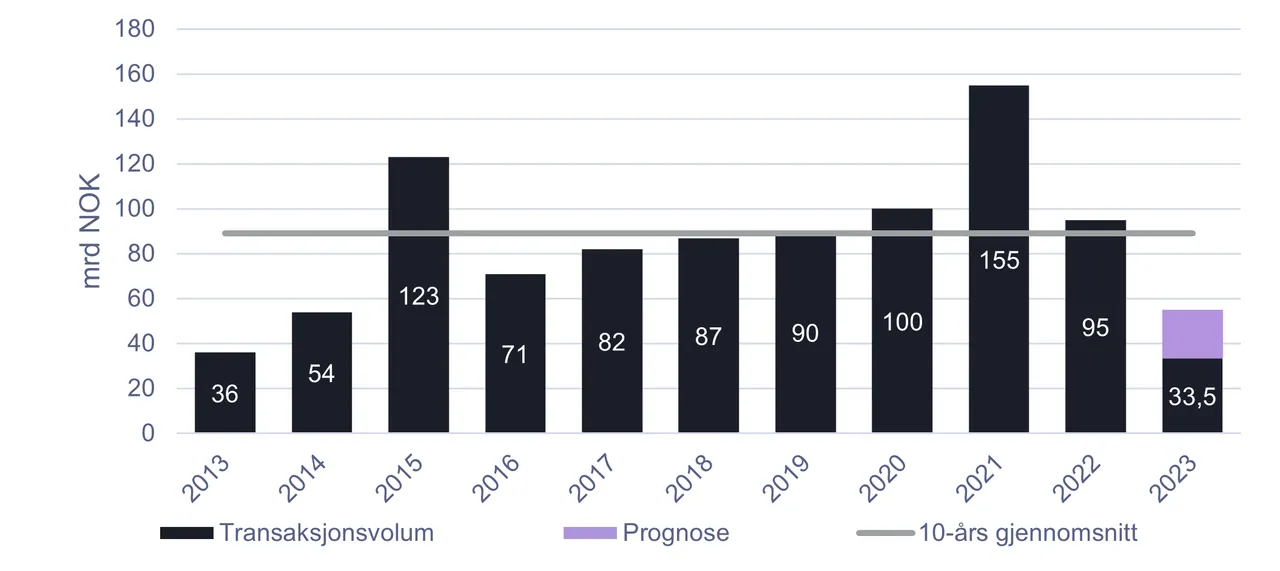
Transaction volume in the third quarter totalled NOK 10.6 bn across 33 transactions. So far this year, total transaction volume stands at NOK 33.5 bn across 119 transactions. The third quarter is usually affected by holidays and the summer months, and the transaction market is normally very quiet after the summer. That is also the case this year, and there are no indications of a change in sentiment in the transaction market. For now there is little movement, and it is expected to be well into 2024 before higher activity is seen in the transaction market. Nevertheless, the third quarter did feature a few large transactions. The largest transaction of the year was completed in September, when Stiftelsen Diakonissehuset Lovisenberg acquired a hospital property and a development site from SBB for over NOK 2.8 bn. In addition, Pareto has acquired Lade Arena from DNB Liv. Lade Arena is a shopping centre and retail park in Trondheim of approx. 70,000 sq m.
The severe consequences of higher interest rates have so far been slow to materialise, but recent times have given us small indications that the market is beginning to change. First and foremost, certain highly leveraged syndicates have felt the impact of changed financing terms. The syndicate behind the Equinor building at Fornebu, among others, has experienced major problems. As a result of lower property values and a higher loan-to-value ratio, the syndicate was forced to raise new capital to avoid breaching its loan covenants. The refinancing was completed, but at an interest rate of a full 15 per cent.
Another sector that has faced headwinds is residential developers. Bakkegruppen recently reported liquidity challenges and has asked its bondholders for a payment deferral. According to the company, an exceptionally weak new-build housing market has led to poor earnings, and the risk of covenant breaches is high. Despite a very poor new-build housing market, there has been relatively good appetite for residential portfolios and residential sites so far this year.
As we have mentioned in previous market updates, the market will probably depend on cases similar to those above for activity in the transaction market to increase. A repricing of property values is needed for the drought in the transaction market to ease. At the same time, following Norges Bank's latest rate rise in September, we have received indications that the rate peak will be reached in December this year. In step with the policy rate rises since the end of 2021, the transaction market has been marked by considerable uncertainty and falling values for most types of commercial property. Increased uncertainty and higher rates have given property investors few incentives to increase their exposure, which has resulted in low activity. Now that we are probably close to the rate peak, market conditions will become more predictable, and it will be easier for property players to navigate an unclear market.
With three quarters of the year behind us, the highest volume has been transacted within offices, with a share of 24%. Residential has accounted for 19%, development property 17%, while warehouse/logistics property, retail property and mixed-use property have accounted for 10%, 5% and 4% of transaction volume respectively.
The office market – stable vacancy, but uncertain property values
The office market is the largest property segment in Norway in terms of total floor area and transaction volume. Within Norway's four largest cities there are approx. 17.4 million sq m spread across more than 4,100 buildings. As in the previous quarter, there is considerable uncertainty about what prime yield is in today's market.
At the same time, there is relatively little doubt that prime yield will rise, and there are good reasons to believe it is considerably closer to 5 per cent than 4 per cent. With swap rates well above 4 per cent, the yield gap is close to zero, implying close to zero risk for the best office buildings in the capital. The large property companies are largely writing down property values at a steady, gradual pace each quarter. In the third quarter of 2023, Entra wrote down property values by NOK 2.2 bn, and it estimates the net yield on its properties at 4.66 per cent (4.42 in Oslo). This is an increase of 78 basis points from the peak in the first quarter of 2022. The share price, on the other hand, is below NOK 100 at the time of writing, valuing the company at roughly NOK 18 bn. The implied yield in the stock market is closer to 6 per cent, while the company's average valuation is considerably lower. In the stock market, the repricing of property values has been done, whereas for book values it is happening more slowly. Whether it is the stock market or Entra's valuers who estimate the "correct" price is impossible to say, but it is fairly obvious that write-downs of book values come with a time lag. We therefore generally expect office property values to continue to fall in the time ahead.
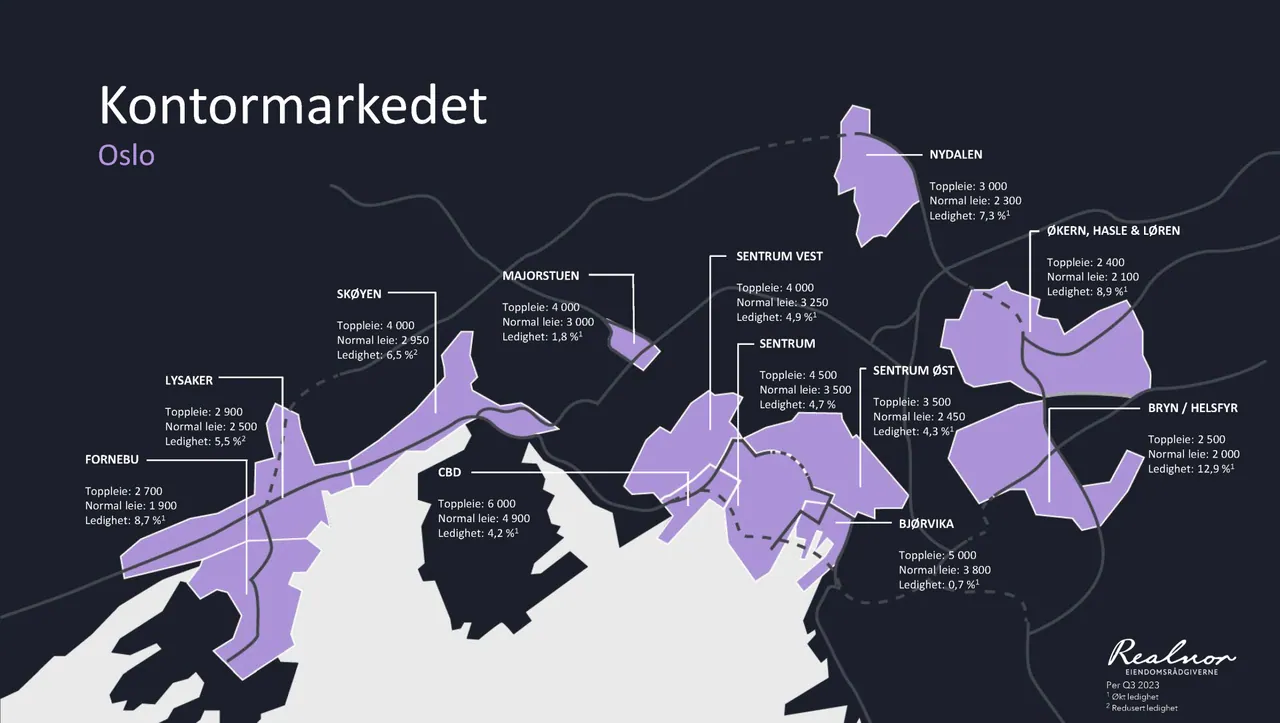
Office vacancy in Oslo stood at 5.9 per cent as of September 2023. This is a slight increase since last quarter, partly as a result of parts of the much-discussed Equinor building (17,700 sq m) at Fornebu coming onto the market. Despite higher vacancy, there has been no significant change in trend in the letting market. The market is holding up relatively well, and expectations going forward have not changed much since last quarter. As a result of reduced economic activity, we expect vacancy in Oslo to increase somewhat in the time ahead. Rental growth will probably also slow, but remain relatively stable.
Logistics transactions fail to materialise
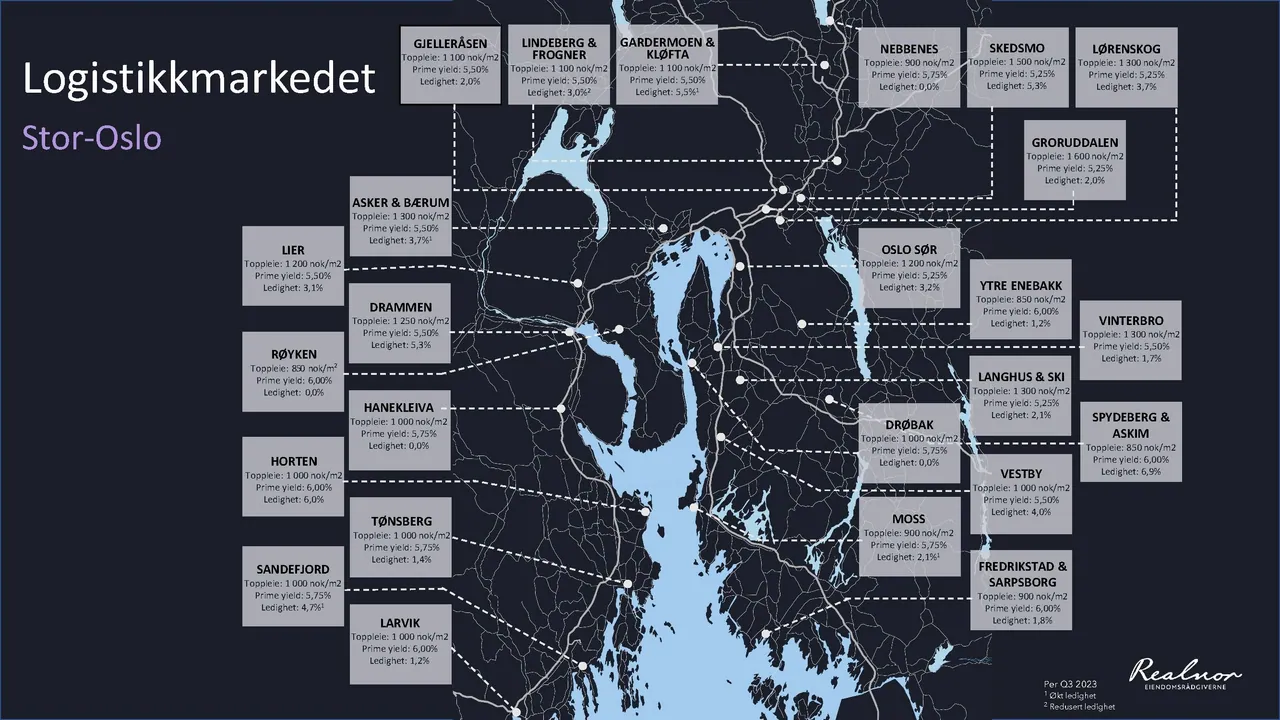
As of September 2023, a transaction volume of logistics and industrial property of just over NOK 3.8 bn has been recorded, accounting for approx. 11 per cent of total transaction volume. In the third quarter only 4 transactions were completed, with a total volume of NOK 382 m, and this development is representative of the year as a whole. Compared with 2021 and 2022, when a number of large transactions of pure cash-flow logistics properties were completed, most transactions now include a value-add element. Nevertheless, we find that appetite for logistics remains good, but investors are not willing to pay as much as before. As with the other segments, a repricing of the market is needed to increase activity.
Shopping centres in the north and the south show the strongest growth
Despite increased uncertainty, higher interest rates, high inflation and the extreme weather event Hans, shopping centre turnover has been relatively good this year. In the third quarter, turnover in the shopping centres included in Kvarud Analyse's shopping centre index rose by 5.2 per cent. So far this year, shopping centres have had turnover 4.5 per cent higher than in the first nine months of last year. Lagunen Storsenter in Bergen remains the country's largest shopping centre by turnover, followed by Strømmen Storsenter and Sandvik Storsenter. Turnover growth must be seen in light of high inflation, as it is higher prices that are pushing growth up.
Geographically, Sørlandet has seen the strongest growth this year. The growth is partly due to weak performance last year and the expansion of one centre. In September, however, growth fell back somewhat, and the region was overtaken by Northern Norway after 7 consecutive months with the highest turnover growth. For shopping centres in Eastern Norway and Innlandet, the third quarter was affected by the extreme weather event Hans. Some shopping centres in Innlandet had to close completely, while others had to close car parks and outdoor seating areas.
Growth rates across the different sectors are evening out. Nevertheless, the "services" and "food and beverage outlets" categories are still some way ahead of the others, with growth of 10.3 and 10.0 per cent respectively this year (nationwide). These sectors have increased their total share of turnover by 0.2 and 0.4 percentage points, taking market share from, among others, "home and interiors" and "clothing, footwear and travel goods". "Food and drink" still holds the largest share, at 29.1 per cent so far this year.
Decline in retail sales – Christmas trading will be decisive for the retail sector
Retail sales fell 0.3 per cent from August to September and have now fallen for three consecutive months, according to SSB. For July and August the declines were 1.0 and 0.3 per cent respectively. In the July–September period, the decline was 0.8 per cent compared with the previous three-month period.
Most sectors saw a decline in the third quarter, with furniture retailing contributing most to the decline in September. So far this year, sales of hardware, paint and building materials have seen the largest fall, with a decline of 12.7 per cent. Specialist stores have also seen a significant decline so far this year, and sales in retailers of leisure boats and equipment have fallen by as much as 17.3 per cent, or around NOK 640 million. At the other end of the scale, grocery sales have risen by 7.8 per cent in the first eight months of the year, but adjusted for price growth, grocery retailing has fallen by 1.1 per cent, according to Kvarud Analyse.
The trend in consumer spending is downward, and it is inevitable that higher interest rates reduce purchasing power and that consumption falls. More people must cut their spending to make ends meet. As a result of further rate rises, consumption is expected to weaken even further in the time ahead. Christmas trading is absolutely essential for players in the retail market, and a decline in the final months of the year will be keenly felt by many. So far this year, it is particularly the sectors in the "home and interiors" category that have felt the tighter financial situation of households. It is clear that the need for renovation has decreased, especially as many people upgraded their homes during the pandemic. In addition, spending is shifting, and households are deprioritising durable goods, sports equipment and specialist goods. Players in these sectors will be particularly negatively affected. Other sectors are less affected and apparently do not obey the law of gravity for downturns.