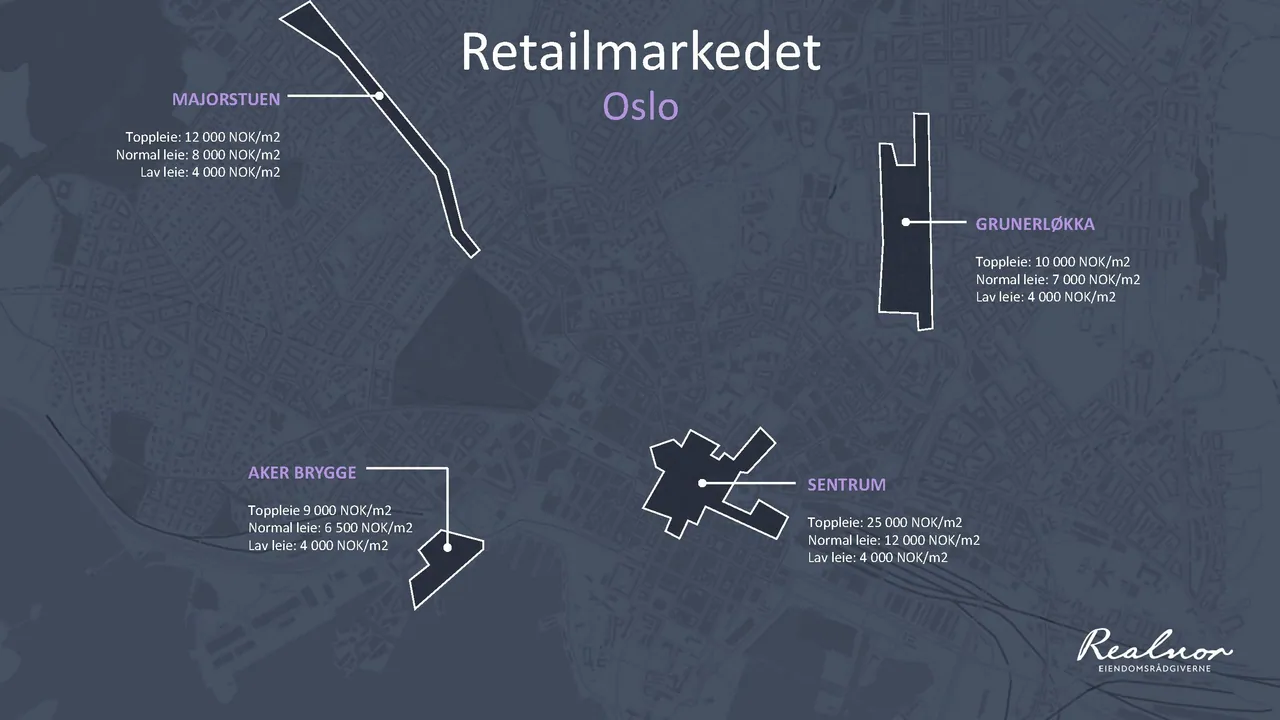
Charts are reproduced from the original Norwegian report.
The global economy is under threat. Where will we land?
We have put behind us a year of war, geopolitical uncertainty, record-high inflation, sharp rate rises and a weakening krone. The new year has also started relatively turbulently, most recently with the banking turmoil in the US and Switzerland, where Silicon Valley Bank and Credit Suisse collapsed. Confidence in the banking sector has been weakened, once again fuelling uncertainty in the markets. Equity indices and the oil price have fallen, resulting in falling policy rate expectations both at home and abroad.
The global economy is probably facing a turning point, and central banks around the world, including Norway's, are doing everything they can to steer their economies towards a soft landing. Central banks thus face demanding trade-offs between economic downturn and high inflation in setting rates. For the Norwegian central bank, the sharp weakening of the krone at the start of the year has also caused further headaches.
SSB, however, considers the likelihood of a severe setback in the international economy to have diminished. This is due, among other things, to the reopening of China, which is very positive for the global economy. In addition, the energy crisis in Europe has been less severe than first assumed, and economic activity is still relatively good. At the same time, SSB stresses that volatility is high and that the Norwegian economy is also facing a turning point. The question, however, is when it will come and how severe the downturn will be. A considerable drop has built up, but the trigger for a recession has yet to be pulled.
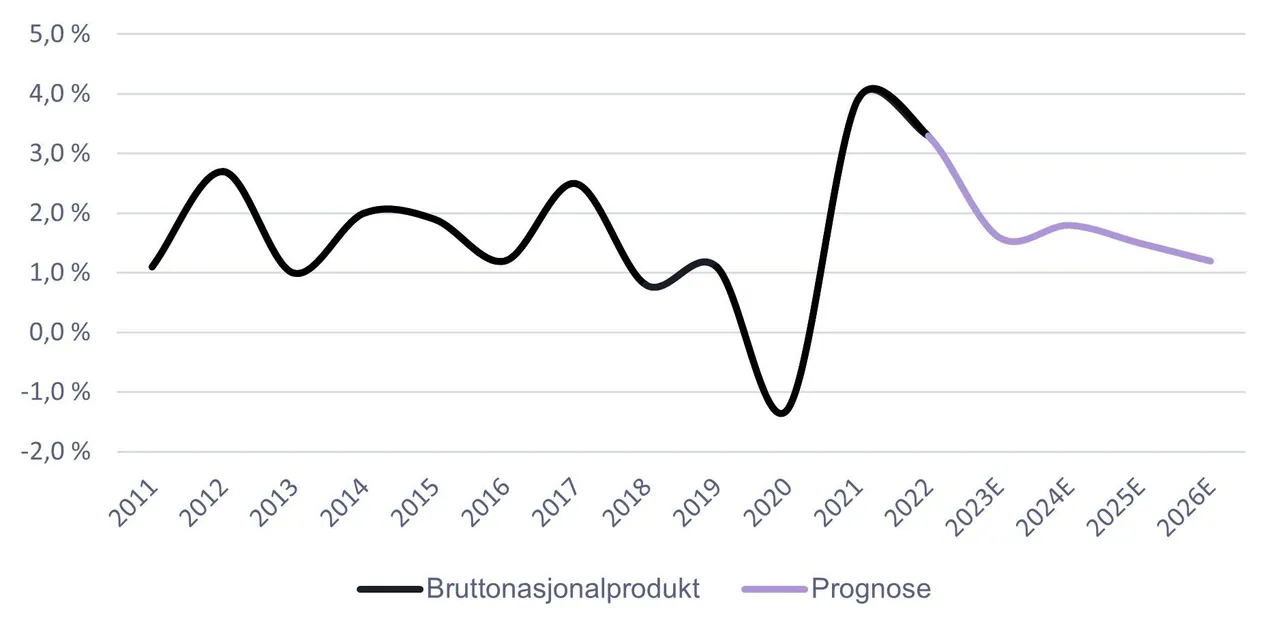
The Norwegian labour market is still tight, and consumption has held up more strongly and for longer than first estimated. Households built up a considerable buffer during the Covid pandemic, which has reduced the impact of the rapid rise in interest rates. SSB nevertheless estimates that economic growth will slow, unemployment will rise and inflation will fall sharply. Gradually we will move towards "normal times", and the economy will grow at a more sustainable pace. According to SSB, mainland GDP growth is estimated at 1.3% in 2023 and 1.6 per cent in 2024.
Higher interest rates may lead to higher unemployment
The Norwegian labour market is still very strong, and in 2022 annual employment growth was 3.9%, equivalent to 110,000 people in employment. In summer 2022 the number of registered unemployed was the lowest since 2012, but since then there has been a low, steady rise in unemployment, according to SSB. Despite this, unemployment is still well below the average for the past five years. In January 2023, unemployment as measured by the Labour Force Survey (LFS) was 3.5%, and in February it rose to 3.6%.
Going forward, SSB expects pressure in the labour market to ease and unemployment to rise. This is mainly due to higher interest rates and lower national and international economic growth. For 2023 and 2024, SSB expects unemployment to end at 3.6% and 3.8%. Towards 2025 and 2026 it will rise further to around 4.0%, according to SSB.
As a result of a very strong labour market, average annual earnings grew by 4.4% from 2021 to 2022, according to preliminary national accounts figures. Despite high wage growth, real wages fell by 1.4% in 2022, as a result of CPI growth of 5.8%. SSB expects annual wage growth of 5.0% in 2023, before it falls to just above 4.0% towards 2026. With a forecast of 5.0% CPI growth in 2023, this implies roughly unchanged real wages this year. From 2024 to 2026, CPI growth will slow, and SSB estimates real wage growth of around 2.5% in those years.
Are we heading for a new interest-rate peak?
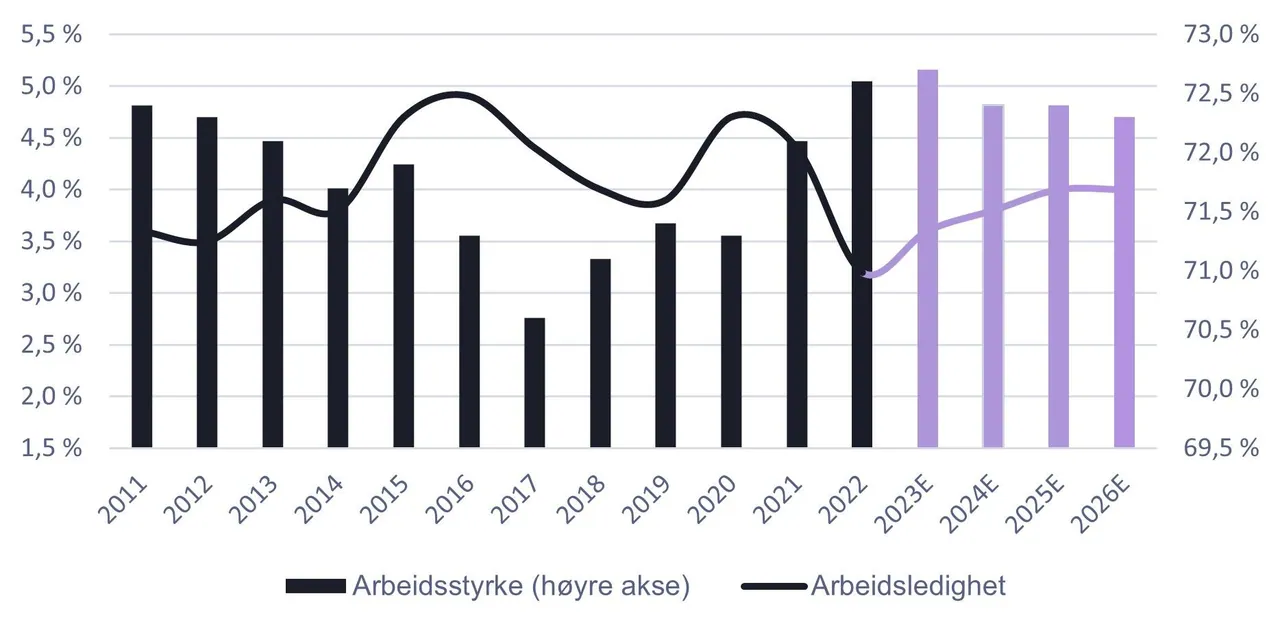
Although inflation is easing, it remains at a high level, and as a result Norges Bank raised the rate by 0.25 percentage points in March. As of March the policy rate stands at 3.00%, an increase of 2.5 percentage points since the start of 2022. Norges Bank faces demanding trade-offs in its rate-setting going forward, with several considerations pulling in different directions.
On the one hand is the consideration for the Norwegian economy. A higher policy rate implies dampened activity and higher unemployment. At the same time, the policy rate has been raised a great deal in a short time, and the effect of the rate comes with a time lag. This argues for an unchanged or lower policy rate in the short to medium term.
On the other hand, inflation is high, and we are currently some way from Norges Bank's inflation target of 2 per cent. Inflation forecasts have been revised up repeatedly, and the labour market is tighter than Norges Bank expected. In addition, the krone has weakened sharply in recent months, and as of 21 March one euro is more than 10 per cent more expensive than the annual average for 2022. The weak krone means that Norges Bank must keep pace with interest rates abroad so that the krone does not weaken further. A further weakening of the krone makes imported goods more expensive and helps keep price growth elevated. This argues for a higher policy rate, which Norges Bank also expressed in its Monetary Policy Report from March.
SSB expects the considerations of inflation and the krone to weigh most heavily and Norges Bank to raise the policy rate. SSB's inflation forecasts have been revised up for 2023, and as a result the forecasts for the policy rate have also been revised up. It expects the policy rate to rise once more in May, peaking at 3.25 per cent. According to SSB, this requires inflation to fall through the year, in line with Norges Bank's and SSB's expectations. Furthermore, the policy rate is expected to be reduced in 2024 as a result of rising unemployment and lower inflation. SSB estimates that the policy rate could fall towards 2 per cent during 2024.
Norges Bank, on the other hand, has revised up its rate forecasts and indicates a policy rate rising to 3.5% this summer. This implies two further rises from the current level. The reason relates to higher wage growth and a weaker krone, which will help lift price growth going forward. The future path of the rate depends largely on developments in inflation and unemployment.
Inflation has probably peaked
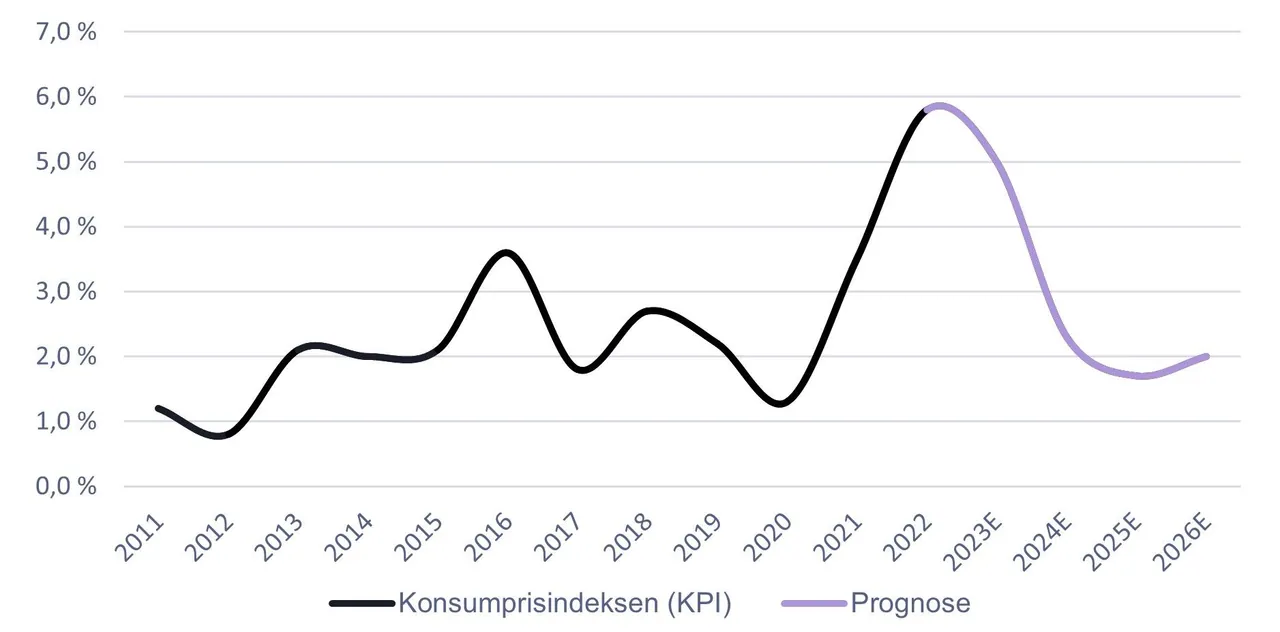
Both CPI and CPI-ATE are expected to come down towards the end of the year, but are projected to remain at a generally high level throughout 2023. Price growth for several inputs and services has come to a halt, while rents and food, among other things, are expected to see strong price growth in 2023 as well. SSB expects CPI of 5.0% for 2023, with a clear downward trend through the year. According to SSB, Norges Bank will not reach the inflation target until 2024 and 2025. CPI-ATE will consistently be somewhat higher than CPI and will not come down towards the inflation target until the first half of 2025.
Inflation, measured by the CPI, ended at 5.8 per cent in 2022. This is the highest consumer price growth recorded since the 1980s. The reasons for the high price growth are many and complex. First and foremost, production capacity in many industries fell during the Covid pandemic. When societies reopened, demand increased and prices took off. Following on from this, the war in Ukraine broke out in February 2022, and an already tight supply situation tightened further. This resulted in a sharp increase in the price of natural gas, which spilled over into electricity prices, both nationally and internationally. The knock-on effects of higher electricity prices were many and led to higher prices for a wide range of goods and services. In addition, the krone exchange rate has weakened sharply, which has led to higher import prices.
At the start of 2023, inflation has also remained at a high level. In January the twelve-month change in the CPI was 7.0 per cent, while in February it fell back somewhat, ending at 6.3 per cent. There is relatively broad consensus that inflation has peaked, owing to, among other things, higher interest rates and lower energy prices. It is also not until the second quarter of 2023 that the twelve-month change in the CPI can be compared against a period of war and energy crisis.
Underlying inflation (CPI-ATE) ended at 3.9 per cent in 2022, the highest ever recorded in Norway. CPI-ATE, unlike CPI, is expected to rise further to annual growth of 5.4 per cent in 2023, according to SSB. This is mainly due to an expectation that energy goods will fall in price, which will pull the CPI down. At the same time, an expectation of a weaker krone exchange rate has lifted the price path, and SSB has therefore revised up its forecasts for CPI-ATE.
Both CPI and CPI-ATE are expected to come down towards the end of the year, but are projected to remain at a generally high level throughout 2023. Price growth for several inputs and services has come to a halt, while rents and food, among other things, are expected to see strong price growth in 2023 as well. SSB expects CPI of 5.0% for 2023, with a clear downward trend through the year. According to SSB, Norges Bank will not reach the inflation target until 2024 and 2025. CPI-ATE will consistently be somewhat higher than CPI and will not come down towards the inflation target until the first half of 2025.
The property market
High interest rates and uncertainty create buying opportunities
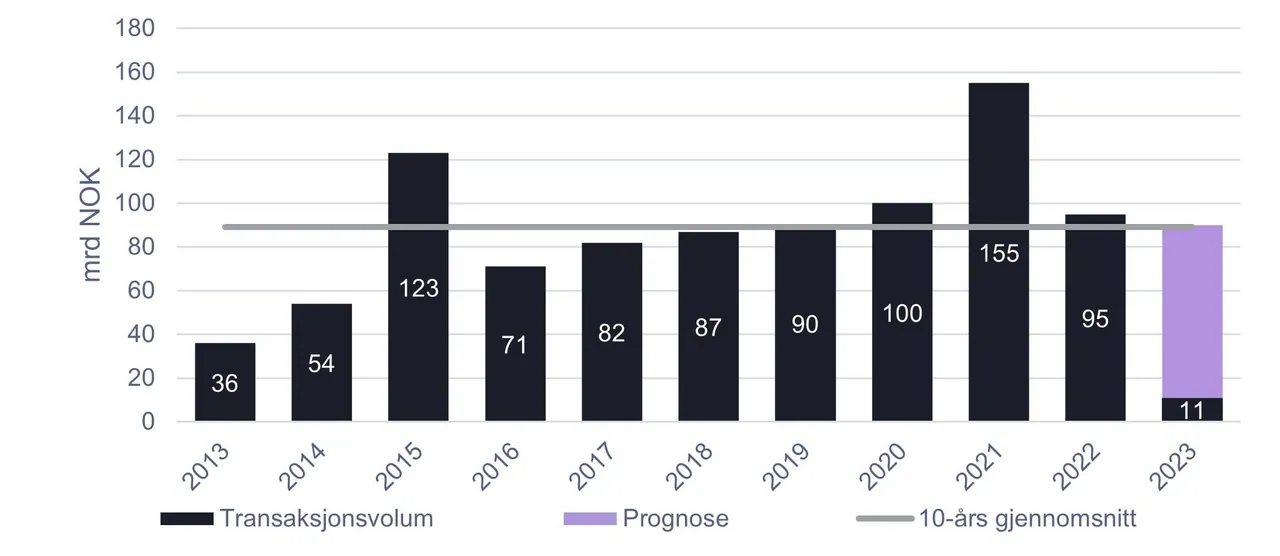
The transaction market in 2022 ended at NOK 95 bn, a relatively good transaction volume in historical terms. Nevertheless, activity slowed sharply in the second half of the year. The trend has continued into 2023, and activity has been very low in the first quarter of the year. In the first quarter of 2023 we recorded a transaction volume of NOK 11 bn across 49 transactions, a decrease of over 50% compared with the average for the past four years.
The development is mainly linked to the sharp increase in, and volatility of, interest rates. The five-year swap rate stood at 3.25% at the end of March, having been both below 3 per cent and at 3.75% during the first quarter. In addition to higher financing costs for investors, banks are also more restrictive, and debt capital is not as readily available as it was a year ago.
The high volatility causes great uncertainty in the property market, and there is very little predictability. Yields are being pushed upwards, and we continue to see a large gap between buyers' and sellers' price expectations. At the same time, it is particularly challenging for property players who need to refinance their bank or bond loans on significantly worse terms. As a result, some players may be forced to sell properties, as has been seen, for example, with the Storebrand property at Lysaker. Potentially, this could mean good buying opportunities for investors who are well positioned and have a strong balance sheet.
A shift can also be seen among certain investors in the types of property they prefer. It is particularly players positioning themselves towards value-add, mixed-use and development property who are most active, while there is little activity among syndicators. Pure cash-flow properties attract less interest and probably need to come down in price to be attractive. The exception is unique office properties in central Oslo, which are rarely available on the market. Such properties attract great interest, and we find that some players are willing to go a long way for properties of this kind.
For development properties, interest is generally good in all segments. At the same time, buyers increasingly want settlement structures with an earn-out, where part or all of the payment is deferred and based on the zoning achieved.
In the first quarter of the year, the highest volume was transacted within the residential segment, with a share of 25%. Offices had a share of 21%, while development and mixed-use property accounted for 16% and 13% of transaction volume respectively.
Strong growth in office rents
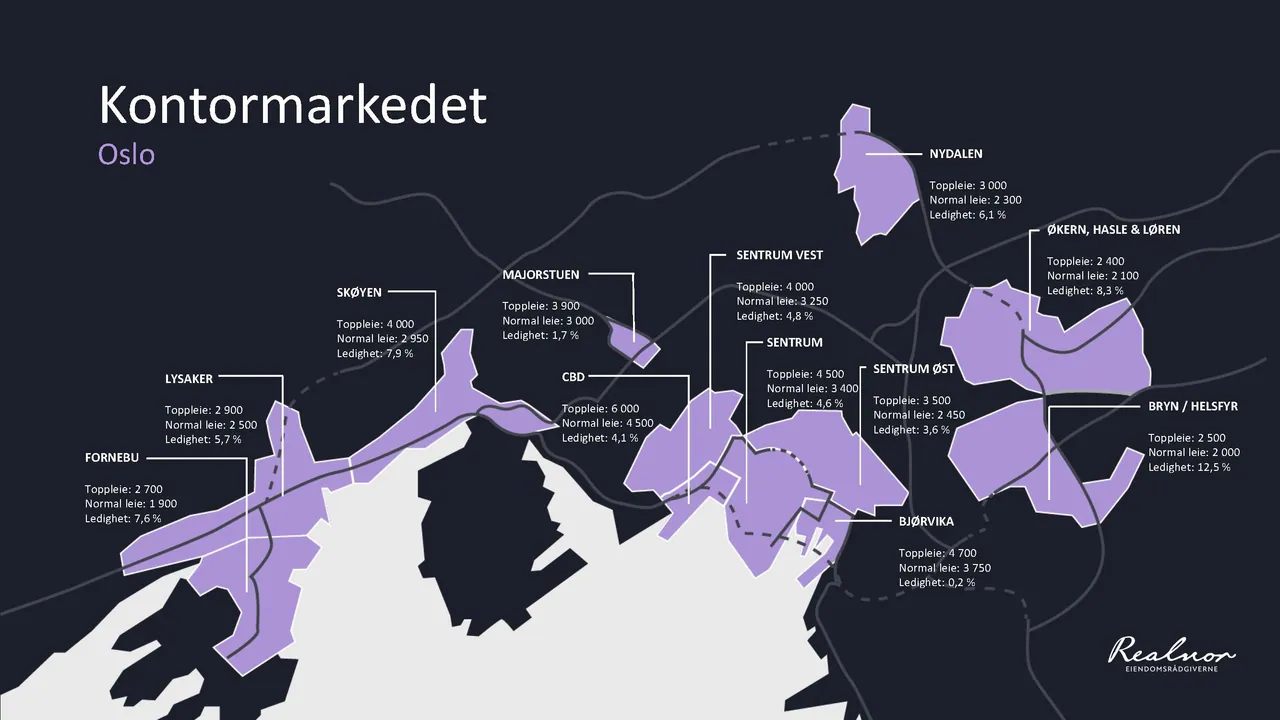
The office market is the largest property segment in Norway in terms of total floor area and transaction volume. Within Norway's four largest cities there are approx. 17.4 million sq m spread across more than 4,100 buildings. The office market is also the market with the highest prime rents and the lowest prime yield levels in the country, currently NOK 6,000 per sq m and 4.00% in the Oslo CBD. Prime yield has been revised up by 25 bps from last quarter. In a market with high uncertainty, however, it is considerably more difficult to estimate what prime yield actually is. We have yet to see transactions that indicate where the level lies, and to confirm this one needs references in the form of transactions in the market. At the same time, we see that prime yield does not necessarily apply to all market participants. It is largely equity buyers who are able to buy at such levels, while for the more interest-rate-sensitive syndicators the prime yield level is 5.25%.
Office vacancy in Oslo stood at 5.7% as of March 2023, a decrease of 1.3% from March 2022. In addition, rent levels rose sharply through 2022. Average annual growth for Oslo ended at 11 per cent, the highest annual growth recorded since 2008, according to Arealstatistikk. The highest growth was in the Oslo Outer West and Oslo Outer East areas. There has also been high activity in the letting market in the first quarter of the year, and rent levels are holding up relatively well in all areas. So far, there is little to indicate a sharp slowdown in the letting market.
We nevertheless expect that much of the rental growth has materialised. The reason for this is mainly expectations of weak future development in the Norwegian economy and higher unemployment. As a natural consequence, demand for office premises will be dampened, and in the short term there is probably no basis for further rental growth.
Following on from the above, high CPI in 2022 led to substantial inflation indexation of leases in 2023. Together with, among other things, higher service charges and higher employer's national insurance contributions, the cost burden for companies is increasing. In this respect, flexible leases play a more important role, and occupiers may need to reduce their floor space. This relationship may also increase demand for flexible office premises, while there may also be more sublease mandates on the market.
Pulling in the opposite direction is a low supply of new office space. The sharp increase in construction costs in 2021 and 2022 resulted in several projects being put on hold. As a consequence, we expect this to balance out the effect of the expected negative development in the Norwegian economy. We therefore expect vacancy and rents for office space to remain at a stable level going forward. The estimate will naturally be strongly affected by how the labour market develops going forward.
Large differences in the logistics market
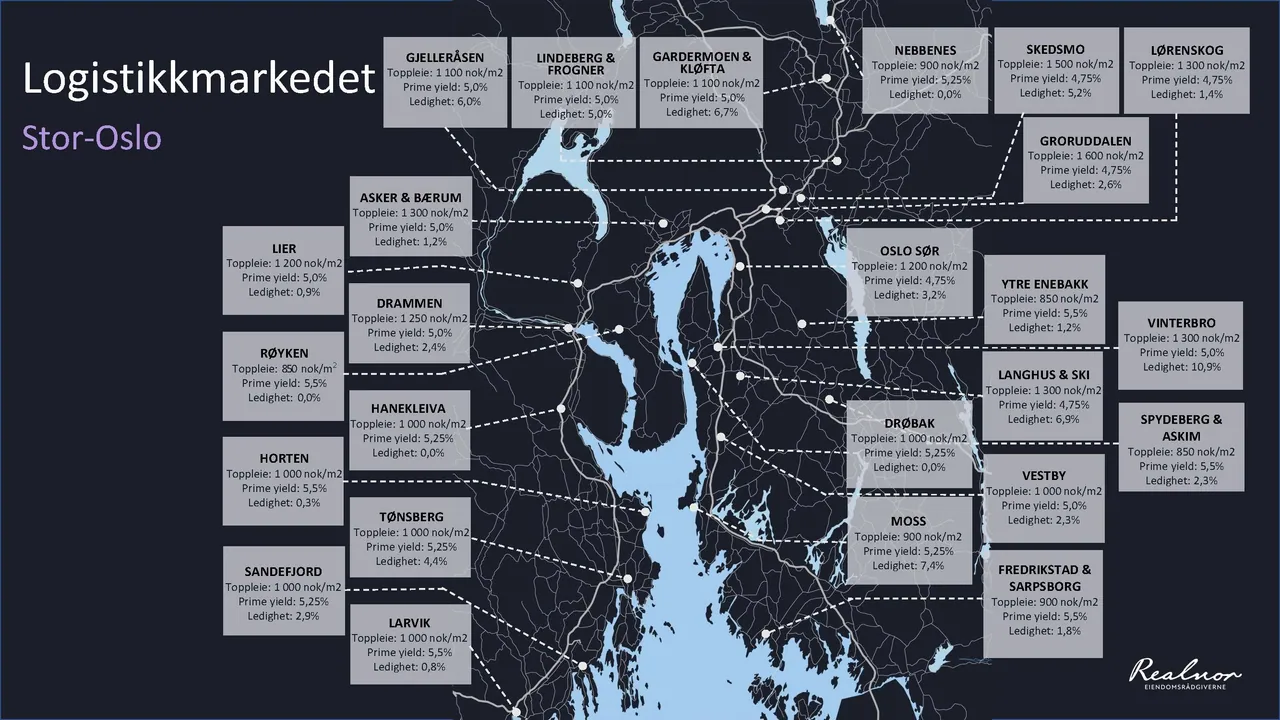
In the first quarter of 2023, a transaction volume of logistics and industrial property of just over NOK 1 bn was recorded, accounting for approx. 10% of total transaction volume. Prime yield has been revised up by 50 bps and stands at 4.75% in the Greater Oslo area. Pending transactions that indicate the prime yield level, it is, as in the office market, difficult to estimate where the level actually lies.
Logistics properties have a prime rent of NOK 1,750 per sq m, and for certain last-mile properties we have seen rent levels of over NOK 2,000 per sq m, as a result of a greater focus on delivery time rather than price. The market for warehousing and logistics property still appears relatively good. At the same time, this segment is also affected by the macroeconomic headwinds. This is particularly noticeable in the transaction market, where few transactions are being completed.
Despite few transactions, LogCap recently acquired a large portfolio consisting of eight logistics properties in Groruddalen, one in Lillestrøm and one in Lørenskog. The portfolio comprised a total of 33,000 sq m of buildings and 81,000 sq m of land. The properties have development potential, which is also receiving increased focus in the logistics market. Properties with upside potential are attracting increased attention and are considered attractive. At the same time, interest in logistics sites in and around Oslo close to the main arterial roads is generally high.
The transaction market has dried up somewhat, but vacancy remains at a stable, low level in the logistics market. As of March, vacancy for logistics and industrial property stands at 2.6% in the Oslo region. There is still strong pressure on the most central areas around Greater Oslo, and newer properties in these areas will probably fare best in turbulent times.
Going forward, household consumption of goods will probably decline as a result of weaker purchasing power. In the shorter term, much of the rental growth may therefore have been realised in the logistics market. In the medium to long term, however, the outlook for the logistics market still looks good.
A good start for the retail market
Despite very high turnover growth for shopping centres last year, the new year has started surprisingly positively. According to Kvarud Analyse, shopping centre turnover rose 5.7% in the first quarter compared with the same quarter last year. Compared with the first quarter of 2019, turnover in Q1 2023 was 14.5% higher. Turnover has increased in all regions and counties, and it is the city centres that have seen the strongest growth. Stores in "home and interiors" and food and beverage outlets performed best, with growth of 10 and 20% respectively.
Developments in the services trade are exceptionally good, and a larger share of total turnover has never been recorded than in February. Food and beverage outlets, service businesses and "other businesses" accounted for a full 13.1 per cent of shopping centre turnover in February. This underlines and reinforces the trend from 2022, when consumers showed a shift towards greater spending on services.
The year has also started relatively well for retail. That said, much of the growth is price-driven and comes as a consequence of strong inflation. This applies particularly to food and non-alcoholic beverages, which were 12.4 per cent more expensive in January 2023 than in January 2022. Comparing retail sales in January this year with January 2019 (excluding sales of motor vehicles and fuel), they are 0.1 per cent lower this year when adjusted for price changes. Developments in the first quarter are, however, negative, and seasonally adjusted retail sales were 1.4% lower than in the last three months of 2022.
In nominal terms, cosmetics stores, shoe and bag stores and clothing stores have seen the strongest growth, with turnover increases of 34.1, 26.3 and 22.6% respectively. For sports stores the trend is the opposite, and for the second year in a row turnover fell in the first two months of the year. After a 20.4% decline last year, the decline has eased, and this year turnover fell by "only" 1.2%. Electrical goods stores and furniture stores have also seen sharp declines in the first two months of the year. This may indicate that households are beginning to feel the rate rises and reduced purchasing power, and that households are cutting back on consumption of specialist, luxury and durable goods.
Following on from the above, households have also become more price-conscious. This applies particularly to grocery stores, where discount chains have seen strong growth. Kiwi in particular has gained market share in the grocery sector after postponing the "usual" price increase on 1 February this year.
This reinforces the assumption that the buffer households built up during the Covid pandemic has been reduced and that the rate rises are beginning to squeeze people's finances. Household consumption accounts for about half of mainland GDP, and the economic slowdown will reduce consumption. As a result, the retail sector will be negatively affected, and in the short term uncertainty and risk are high for many players. In the wake of this, negotiations between landlords and occupiers will become tougher going forward, and for some premises rents will probably be pushed down. The effect has already begun to be felt and is particularly evident in lease renegotiations.